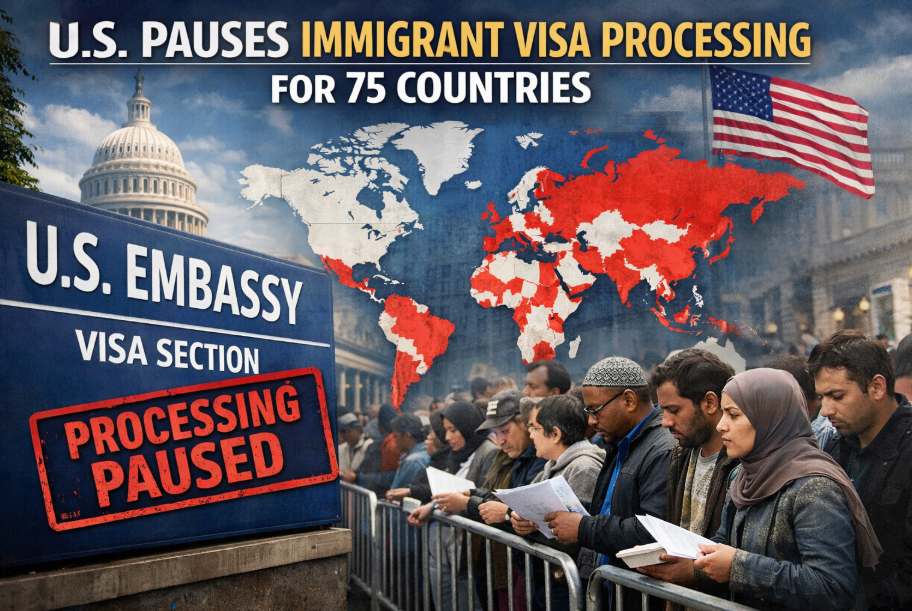
On January 14, 2026, the U.S. Department of State (DOS) stated that, effective January 21, 2026, it will suspend issuing immigrant visas to nationals from 75 countries. These countries are considered “high risk” for using public benefits.
The move has introduced uncertainty for thousands of applicants worldwide, particularly those who have already completed interviews or are close to final approval.
Key Takeaways:
- Pause began January 21, 2026, affecting immigrant visa issuance at US embassies in 75 countries
- Family-based and employment-based immigrant visas are on hold; diversity visa (green card lottery) applicants are also affected
- Non-immigrant work visas (H-1B, L-1, O-1) and student/visitor visas (F-1, B-1/B-2) are NOT affected
- Adjustment of Status applications filed inside the United States continue normal processing
- No official end date announced; pause tied to public charge policy review
Also Read: U.S. Expands Visa Pause Full and Partial Bans Now Affect 39 Countries
Which Types of Visas and Applicants Are Affected?
The pause announced by the U.S Department of State, starting January 21, 2026, applies specifically to immigrant visas. These visas grant lawful permanent resident status (often leading to a Green Card) for people outside the United States.
Visa Processing Status During the Pause:
| Visa Category | Status | Processing |
|---|---|---|
| Family-Based Immigrant Visas (IR, F1–F4) | PAUSED | On Hold |
| Employment-Based Immigrant Visas (EB-1 to EB-5) | PAUSED | On Hold |
| Diversity Visa (DV / Green Card Lottery) | PAUSED | On Hold |
| H-1B Work Visa | ACTIVE | Normal |
| L-1 Intracompany Transfer | ACTIVE | Normal |
| F-1 Student Visa | ACTIVE | Normal |
| B-1/B-2 Tourist/Business Visa | ACTIVE | Normal |
| O-1 Extraordinary Ability Visa | ACTIVE | Normal |
| Adjustment of Status (Inside U.S.) | ACTIVE | Normal |
Countries Affected By Visa Pause
Morocco, Saint Lucia, Ethiopia, Kuwait, Barbados, Liberia, Kyrgyz Republic, Guatemala, Grenada, Burma, Cameroon, Bangladesh, Nigeria, Lebanon, Cape Verde, Jordan, Eritrea, Fiji, Belize, Laos, Georgia, Albania, Tanzania, Afghanistan, Somalia, Rwanda, Democratic Republic of the Congo, Uruguay, Moldova, Bhutan, Bosnia and Herzegovina, Uzbekistan, Iraq, Haiti, Russia, Colombia, Nepal, Uganda, Sudan, North Macedonia, Cambodia, Egypt, Algeria, Saint Kitts and Nevis, Togo, Armenia, Nicaragua, Montenegro, Tunisia, Ghana, The Gambia, Guinea, Antigua and Barbuda, Jamaica, Syria, Dominica, Kosovo, Pakistan, Republic of the Congo, Senegal, Mongolia, Brazil, Saint Vincent and the Grenadines, Yemen, Sierra Leone, South Sudan, Thailand, Libya, Kazakhstan, Cote d’Ivoire, Azerbaijan, Iran, Cuba, Belarus, Bahamas
Exceptions Applicants Should Be Aware Of
Dual nationals applying with a passport from a non-affected country still be eligible for visa issuance, depending on embassy guidance.
Applicants adjusting status inside the United States are not impacted, and certain case-specific exceptions apply based on post-level instructions. Because these exceptions vary, individual case review is essential.
If you are unsure whether your visa category or applicant profile is affected, it is important to get clarity early. Small details, such as employer type, funding source, or job role, can change how a policy applies to your case.
Practical Implications for Applicants, Families, and Employers
For families: Delays can impact family reunification plans, including spouses, children, and other dependents awaiting immigrant visas. Families should plan for extended timelines and monitor embassy communications closely.
In our experience, family-based cases often face the greatest uncertainty during consular pauses, especially when interviews have already taken place, but visa issuance is pending.
For employers: Companies hiring foreign nationals need to adjust onboarding schedules or consider alternative visa strategies while the pause is in effect. Early planning and consultation with immigration counsel can help mitigate disruptions.
Families and employers should ensure that all supporting documentation is current and complete to avoid further delays once the review concludes.
Public Charge Policy and Administrative Implications
The current visa pause is closely tied to the broader application of public charge considerations in consular adjudication. Under this policy, consular officers assess whether an applicant is to rely on government benefits after entering the United States.
Critics say the indefinite pause and broader discretionary standards unfairly affect certain nationalities or visa categories. The ongoing suspension of immigrant visa issuance raises several questions about administrative rules and government authority.
Key concerns include:
- Indefinite review period: Without a defined timeline, applicants face uncertainty, which can complicate planning for families and employers.
- Potential litigation avenues: Legal challenges arise under constitutional or statutory arguments, including claims of arbitrary or capricious administrative action.
- Congressional oversight: Lawmakers seek clarification or intervention to ensure the timely processing and equitable treatment of affected applicants.
Common Mistakes Applicants Make During a Visa Processing Pause
One common mistake is assuming all visa categories are affected. In recent pauses, only immigrant visa issuance was suspended, while 100% of non-immigrant visas and Adjustment of Status cases inside the U.S. continued processing.
Another issue is ignoring embassy follow-ups. Even during pauses, consulates request updated financial or civil documents. Failure to respond within stated deadlines, often 30 to 90 days, can result in case of inactivity or administrative closure.
Applicants also make changes to employment or family details without guidance. In employment-based cases, even minor job duties or employer changes can require reassessment of eligibility.
Get Expert Help from VisaPro During the Visa Pause
Navigating visa pauses and complex policy changes can be stressful for families, workers, and employers alike. VisaPro is here to help you understand your options and plan your next steps.
Contact VisaPro today for expert guidance and schedule a free assessment to review your case and explore alternatives while the pause is in effect.
Frequently Asked Questions (FAQs)
1.Are visa interviews still happening during the pause?
Yes, interviews continue at US embassies and consulates, but final immigrant visa approvals are temporarily on hold.
2.Does the pause affect non-immigrant visas like H-1B or F-1?
No, Nonimmigrant visas including H-1B, L-1, F-1, B-1/B-2, and O-1 are processed normally.
3.Are U.S. residents applying for an adjustment of Status impacted?
No, the pause applies only to consular processing abroad; Adjustment of Status applications inside the U.S. are not affected.
4.Which countries are included in the visa suspension?
The pause affects nationals of 75 countries across Africa, the Middle East, Asia, Europe, the Caribbean, and Latin America.
5.Can dual nationals apply using a different passport?
Yes, dual nationals with a passport from a country not on the affected list may still be eligible for visa issuance.