STEM OPT participants are subject to site visits by U.S. Immigration and Customs Enforcement (ICE) as part of DHS oversight of the program. These visits verify that students are genuinely working in a STEM related role at the employer’s reported location. Being prepared for a site visit is essential to maintaining your STEM OPT authorization and avoiding program violations.
Key Takeaways
- ICE conducts unannounced site visits to verify STEM OPT compliance at employer locations
- Site visits confirm that training plans are being followed and work is STEM related
- Employers must retain I 983 training plans and be prepared to present them during visits
- STEM OPT students should always be reachable at the employer’s reported work address
- A failed or uncooperative site visit can result in STEM OPT termination
- Employers must employ STEM OPT students in bona fide positions, not as contract labor for third parties
- Remote work arrangements must be properly documented and reflected in SEVIS records
- Students and employers should jointly review compliance requirements before any DHS communication
Understanding STEM OPT Site Visit Risks During H-1B Cap Gap Status
STEM OPT site visits are unannounced compliance checks where ICE or USCIS officers verify that your employment meets all regulatory requirements for the 24-month STEM OPT extension. During cap-gap, the period between your OPT expiration and H-1B start date, you’re in a particularly vulnerable position because any STEM OPT violation immediately terminates your legal status and jeopardizes your pending H-1B change of status petition.
The STEM OPT employer compliance standards require a genuine employer-employee relationship with structured training, formal supervision, and clear educational objectives documented in your I-983 Training Plan. During cap gap, any finding of noncompliance can immediately terminate STEM OPT and automatically end cap gap protection.
For many international professionals, the cap gap period feels like a waiting room, tense, uncertain, and completely out of your control. You are still working, still contributing, and still counting on your H-1B approval to carry you forward. A site visit during this phase is not routine paperwork; it is a high-stakes compliance audit.
Why cap-gap increases scrutiny
- USCIS already has your file open due to the pending H-1B petition
- Any violation of F-1/STEM OPT status can undermine the H-1B change of status
- Findings are often shared across agencies, not siloed
Real-life example:
Priya assumed the H-1B petition insulated her from STEM OPT issues. In reality, the site visit triggered a chain reaction that directly threatened her pending change of status.
VisaPro tip:
If you are in cap gap, treat your STEM OPT compliance as if it will be audited tomorrow, because it can be.
How a STEM OPT Site Visit Works and What Officers Actually Look For
During a STEM OPT site visit, officers verify the legitimacy of the employer-employee relationship, confirm compliance with the STEM OPT I-983 requirements, and assess whether the employer, not a third party, controls and trains the student.
A STEM OPT site visit is not adversarial, but it is methodical. Officers typically arrive unannounced and ask structured questions designed to expose inconsistencies.
What officers commonly review
- Physical presence of the employer
- Who supervises and evaluates your work
- Whether the training plan is actively followed
- Proof that you are not simply placed at a client site
Quick checklist: Are you site-visit ready?
| Compliance Area | Red Flag |
|---|---|
| Employer control | Staffing agency manages placement only |
| Training plan | Generic, vague, or copied I-983 |
| Supervision | Supervisor not on payroll |
| Work location | Constant third-party sites |
Myth to dispel:
“My employer filed my H-1B, so STEM OPT doesn’t matter anymore.”
This is false. STEM OPT compliance remains legally required until your status changes.
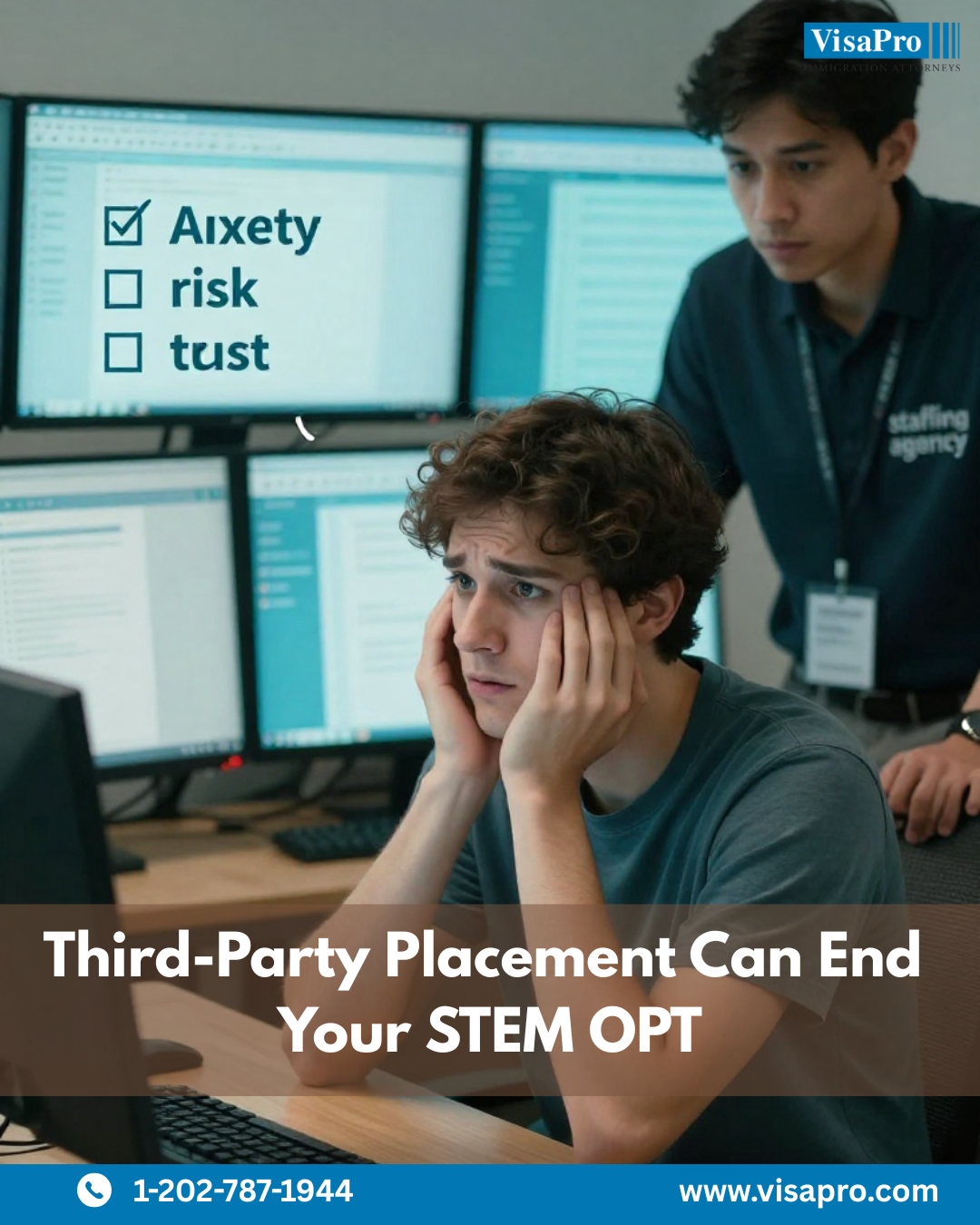
STEM OPT Employer Compliance: Why Staffing Agency Models Are High Risk
STEM OPT employer compliance requires a bona fide employer-employee relationship with direct supervision, training, and evaluation, conditions often missing in a staffing agency model.
In Priya’s case, USCIS discovered that her “employer” primarily functioned as a placement entity. The training plan described mentorship that did not exist in practice.
Why staffing agencies struggle with compliance
- Training is outsourced or hypothetical
- Supervision happens at third-party client sites
- Employer lacks day-to-day control over duties
Case scenario comparison
| Employer Type | STEM OPT Risk |
|---|---|
| Direct product company | Low |
| In-house consulting firm | Medium |
| Third-party staffing agency | High |
Actionable guidance:
If your role depends on third-party placement, you should proactively review STEM OPT employer compliance with counsel, before a site visit exposes structural flaws you cannot fix retroactively.

How STEM OPT Termination Immediately Ends Cap-Gap Protection
When STEM OPT is terminated, cap gap authorization may also end automatically because cap gap is legally dependent on valid F-1 status, creating immediate H-1B cap gap issues.
This is where panic often sets in. Priya assumed she had “time” because her H-1B was still pending. Unfortunately, the law does not provide a grace buffer once STEM OPT ends in violation.
Immediate consequences
- Work authorization stops the same day
- You are considered out of status
- Accrual of unlawful presence may begin
Quiz: Are you still protected by cap gap?
- Is your STEM OPT active and compliant?
- Has no termination notice been issued?
- Are you still employed by the I-983 employer?
If any answer is “no,” cap-gap may already be gone.
Your H-1B petition itself might still be approved because USCIS evaluates the petition separately from your status. However, your change of status request will likely be denied because you weren’t maintaining lawful status when it was filed. This means your H-1B approval may become “consular processing only”. You will need leave the U.S. and obtain an H-1B visa stamp abroad before you can return and begin working.

Understanding the Legal Distinction That Destroyed Priya’s Case
The critical STEM OPT I-983 requirements demand that your employer provide structured, formal training directly related to your STEM degree field. The training must be supervised by experienced personnel employed by your sponsoring company, documented with specific learning objectives, and regularly evaluated.
Priya’s arrangement failed every test. Her staffing agency employer had no capacity to provide training because they didn’t control her work environment. The client company had no legal obligation to train her because she wasn’t their employee. This created a regulatory vacuum where nobody was responsible for her STEM training, making her extension fraudulent from USCIS’s perspective.
The Consular Processing Trap After Status Violations
Applying for an H-1B visa at a consulate after a status violation creates additional risks. Consular officers have access to your ICE and USCIS records and will see the STEM OPT termination. They may question whether you knowingly violated your status, whether you’re likely to comply with H-1B requirements, and whether you’ve been truthful in your applications.
Some visa applicants face lengthy administrative processing or outright denials after USCIS terminates their previous status. Even if you eventually receive the visa, you’ve lost months of work authorization and incurred significant travel and legal expenses.
Lastly, you also become subject to the $100,000 H-1B Fee!
Preventing STEM OPT Compliance Disasters: What You Must Do Now
If you’re currently on STEM OPT or planning to apply for the extension, take immediate action to prevent Priya’s fate. The most important step is conducting an honest assessment of your employment arrangement before USCIS does it for you.
Review your employment structure critically:
Examine whether your employer truly controls your work or whether you’re essentially a contractor placed at a client site. If you work at a client location, does your sponsoring employer provide meaningful supervision and training, or are they merely your nominal employer while the client directs everything you do?
Look closely at your I-983 Training Plan. Are the learning objectives genuinely related to your actual job responsibilities? Do you have documented training sessions with your employer’s personnel? Can your supervisor accurately describe your progress toward the stated training goals?
Building Defensive Documentation
Even if your employer meets compliance requirements, you should maintain your own defensive documentation. Keep copies of all training materials, evaluation reports, email communications with your supervisor, and records of formal training sessions.
Document your work location and supervisor contacts. If USCIS conducts a site visit, you need to prove immediately that your arrangement complies with regulations. Having organized records can mean the difference between passing inspection and immediate termination.
Frequently Asked Questions (FAQ)
USCIS conducts stem opt site visits randomly or when they suspect compliance issues based on employer characteristics, student complaints, or patterns suggesting fraudulent arrangements. Site visits are unannounced and can occur at any time during your 24-month extension period.
Yes, but only if they maintain genuine employer-employee relationships with direct supervision and structured training. Most STEM OPT staffing agency arrangements fail because the agency doesn’t control the student’s work or provide actual training. They simply place students at client sites without fulfilling I-983 requirements.
The I-983 Form must include specific, measurable training objectives directly related to your STEM degree, identify an employer supervisor who actually oversees your work, document formal training plans and evaluation schedules, and reflect genuine educational goals beyond simply performing job duties.
If your STEM OPT is terminate, your cap gap extension may also end as your SEVIS is terminated due to a violation. USCIS will likely deny your change of status request, requiring you to leave the U.S. and apply for an H-1B visa at a consulate abroad before you can return.
A denial of your H-1B change of status occurs when USCIS determines that you were not in status at the time your H-1B petition was filed. USCIS separates the petition approval (whether you qualify for H-1B) from the change of status approval (whether you can transition to H-1B while remaining in the U.S.), and status violations disqualify you from the latter.
Evaluate whether your employer directly supervises your work, provides structured training with documented learning objectives, employs the supervisor listed on your I-983 form, and maintains regular contact with you about your training progress, if a client company controls these elements instead, your arrangement likely fails compliance requirements.
Remain calm and professional, provide requested documentation including your Form I-983 and EAD card, answer questions truthfully about your work and training, and contact an immigration attorney immediately afterward to assess the visit’s implications and prepare for potential consequences.
Reviewed By Immigration Attorney
The VisaPro Advantage: Expert Guidance When Everything Is at Stake
Navigating stem opt employer compliance and h-1b cap gap issues requires specialized legal expertise that most employers and students don’t possess. VisaPro’s experienced immigration attorneys understand exactly what USCIS looks for during site visits and can help you evaluate your risk and take corrective action before problems arise.
If you’re concerned about your current STEM OPT arrangement, especially if you’re in cap-gap status with an approved or pending H-1B, don’t wait until a site visit exposes problems. Contact VisaPro today for a free visa assessment to review your employment structure, I-983 compliance, and H-1B status implications. Our attorneys can help you understand your risks and develop strategies to protect your immigration status.
For students like Priya, the difference between success and deportation often comes down to understanding compliance requirements before USCIS enforces them. Let VisaPro’s expertise guide you through the complex intersection of STEM OPT regulations and H-1B transitions. Schedule your free consultation now and protect your American dream before it’s too late.
What VisaPro Customers Are Saying
The US [B-1] Visa has always been a tough ride, and being denied a few times it makes it even worse. But thanks to VisaPro and their meticulous processing I was granted a Visa. I would like to thank you and all the people involved in making this a success. I would like to recommend VisaPro to all those who seek peace of mind and hassle free Visa processing.”
 Manas Bhat, Director Operations, First Houston Mortgage India