Quick Summary:
If a consular officer believes you plan to enter the U.S. on an F-1 visa but actually intend to stay for your future H-1B job, they can deny your visa, and force you to remain abroad until the opportunity to enter on an H-1B visa opens. This guide helps you understand these hidden risks, and how to travel safely during the F1 to H1B transition.
Understanding Sudden F-1 Visa Failure Points
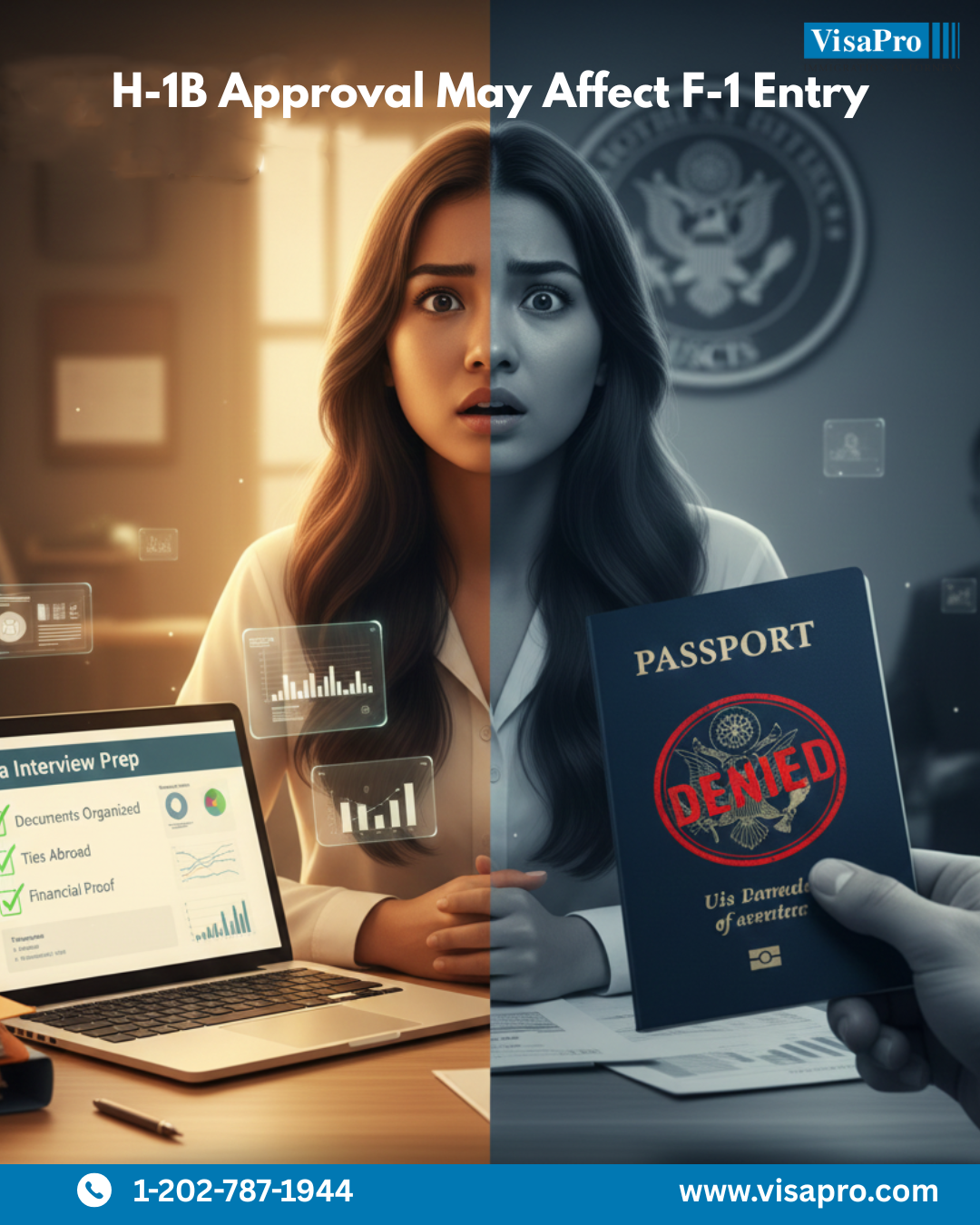
F-1 visas do not allow dual intent, so any evidence that you may plan to stay in the U.S. long-term, such as an approved H-1B, can cause a denial of the F-1 visa. Officers can refuse an F-1 visa renewal if they believe you do not intend to leave the U.S. after your educational activities.
An F-1 student must show nonimmigrant intent. But the moment an H-1B is approved, your future plans can be viewed as inconsistent with your F-1 status, creating a hidden consular risk renewing your visa.
Why This Matters Now
Thousands of F-1 students transition to H-1B status each year, but many are unaware that simply having an H-1B approved can trigger questions at the consulate such as:
“Why are you returning on an F-1 visa if you already have a U.S. job waiting?”
This exact question caused Priya’s F-1 denial at the Chennai consulate, leaving her stuck in India for months and nearly costing her October 1 start date.
VisaPro Tip
If your H-1B change of status was already approved, we strongly avoid all non-emergency international travel until after October 1 if you need to renew your F-1 visa unless you speak with an immigration attorney.

Why F-1 + Approved H-1B = High Consular Risk
Having an approved H-1B while seeking to enter on an F-1 visa is likely to leads officers to conclude you no longer have the intention to return to your home country. This conflict increases your consular risk, especially during travel while H-1B is pending or approved.
Immigration law views F-1 as a nonimmigrant category with no dual intent. The officer’s job is to prevent misuse. Seeing your H-1B in the system can create suspicion that you plan to remain in the U.S., even if you are fully compliant.
Three Real Scenarios Showing Consular Risk
| Scenario | What Happened | Risk Level |
|---|---|---|
| Priya (India) | F-1 visa renewal denied because officer questioned intent after seeing approved H-1B | Very High |
Why Consular Officers React This Way
- F-1 students must intend to return home after their education is completed.
- H-1B shows clear long-term employment intent.
- Officers are trained to reject applicants whose stated intent does not match their future plans.
This contradiction is where most denials happen.
VisaPro Tip
If you must travel, carry a travel intent package: enrollment letter, transcript, OPT proof, employer letter (if on OPT), and a personal statement explaining why you still need F-1 entry.
The “Dual Intent Visa Meaning” Problem Explained
A dual intent visa allows you to enter temporarily while intending to apply for a green card. H-1B and L-1 are dual intent; F-1 is not. F-1 students cannot show immigrant intent at any time.
Officers use the dual intent visa meaning test to decide if your long-term plans match the visa. When your future H-1B shows immigrant intent, but you enter on F-1, they may find your intent inconsistent.
What Officers Ask to Test Intent
- Do you have a job offer?
- Have you filed or approved an H-1B?
- Are you planning to return home after studies?
- Are you traveling for genuine reasons?
- Failing these can lead to a visa denied outcome.
Common Myths Students Believe
“Having an approved H-1B doesn’t affect my F-1 visa application.”
It absolutely can.
“If my H-1B start is months away, I’m safe.”
You can still be denied even in July or August.
“My friend traveled and had no issue, so I’m fine.”
Every officer, port, and case is different.
VisaPro Tip
Never rely on other students’ experiences, your case may be flagged due to your university, your DS-160, your previous travel history, or simply the officer’s discretion.
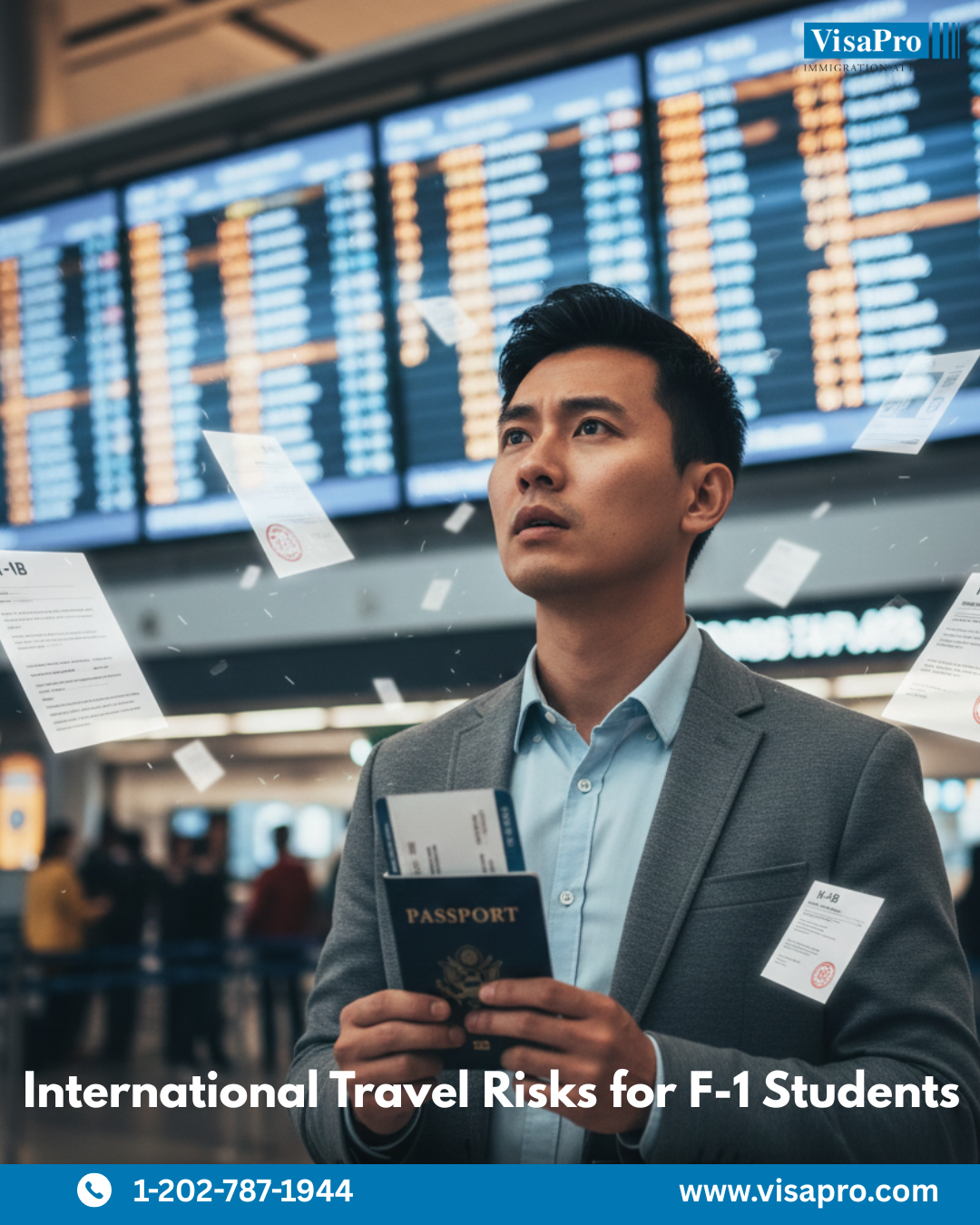

F1 to H1B Travel Risks Before October 1
Traveling internationally between H-1B approval and October 1 puts your F-1 status and U.S. reentry at significant risk, especially if you have to apply for a new F-1 visa. Even if the H-1B change of status is approved, travel can cancel it.
If you depart the U.S. before COS approval, you automatically convert your H-1B to “consular processing,” meaning you must get an H-1B stamp in your passport before reentry.
The Critical Timeline: A Visual Chart
March–April: H-1B Lottery Selected
│
May–July: H-1B Approved (COS)
│
AUGUST: HIGHEST RISK PERIOD for F-1 travel
│
October 1: H-1B Status Activation
The months between approval and October 1 are the danger zone.
Why Travel Is So Risky
- Officers can deny F-1 visa renewal due to H-1B approval.
- Travel cancels change of status if you travel while it’s pending, forcing you into stamping.
- H-1B stamping delays can cause you to miss your job start date.
Many students don’t realize that even a short trip can undo months of work.
VisaPro Tip
If you must travel, ask your employer if they can delay your start or issue an updated employment letter confirming your October 1 plan.
How “Travel While H1B Pending” Can Trigger Denials
Leaving the U.S. while your H-1B change of status is pending results in automatic abandonment of the COS portion, leaving only consular processing. This increases your risk dramatically.
Students often misunderstand this rule and believe travel is safe because their case is pending. In reality, USCIS treats departure as abandonment.
Case Example: The “Almost Approved” Disaster
Rina traveled to Mexico while her employer’s H-1B was pending.
Her COS was denied due to abandonment.
She had to:
- finish her F-1 program
- leave the U.S.
- get an H-1B stamping abroad
This delayed her job start by 8 weeks.
Checklist: Should You Travel While H-1B Is Pending?
| Question | If YES → You Should NOT Travel |
|---|---|
| Is your case filed with change of status? | ✓ |
| Do you need a new F-1 visa entry to return? | ✓ |
| Would stamping delays harm your job timeline? | ✓ |
VisaPro Tip
If travel is unavoidable, ask your employer to refile your H-1B under consular processing proactively rather than letting USCIS deny the COS after you travel.
H1B Stamping in India After a Border Denial
If your F-1 is denied abroad, you typically must wait until you qualify for H-1B stamping in India before returning. This may delay your return by weeks or months.
Denials often push students into emergency stamping appointments, administrative processing, or 221(g) delays, especially during peak seasons in Mumbai, Delhi, Hyderabad, and Chennai.
What Happens After an F-1 Denial
- You cannot return on F-1.
- Your only option is to enter on H-1B.
- You must schedule a new H-1B stamping appointment.
If slots are unavailable, your return may be delayed until after October 1.
Table: Typical H-1B Stamping Delays in India
| Consulate | Peak Wait Time | 221(g) Risk |
|---|---|---|
| Chennai | 20–45 days | High |
| Hyderabad | 15–30 days | Medium |
| Delhi | 25–50 days | High |
| Mumbai | 20–60 days | Medium |
VisaPro Tip
Before traveling, check consulate appointment availability, even if you don’t expect to need H-1B stamping.

Frequently Asked Questions (FAQ)
Dual intent allows a person to enter the U.S. temporarily while planning a long-term stay. The F-1 visa does not permit dual intent. If you have an approved H-1B, officers may doubt your nonimmigrant intent and deny entry or visa issuance.
Travel while an H-1B change of status is pending results in abandonment of the change of status portion. The petition may continue, but you must obtain an H-1B visa stamp abroad to reenter the U.S.
A denial means you cannot reenter on F-1 and must wait until your H-1B stamping window opens. This can delay your job start or force employer rescheduling.
Travel is legally allowed but risky. Officers may misinterpret your intent and deny entry, especially between approval and October 1.
The main risk is inconsistent intent. Officers can question why you are returning on F-1 when your H-1B job is waiting, leading to denial or secondary inspection.
Risk increases significantly once the officer sees your H-1B in their system. Many students face denial because officers believe they are trying to enter with immigrant intent.
It is extremely risky and should be avoided. Consular officers are likely to deny the visa application based on long-term employment plans shown by the H-1B approval.
Yes, but expect questions. Even a pending H-1B can raise doubts, though approved cases may create much higher risks.
Reviewed By Immigration Attorney
Ancy S. Varghese is a U.S. immigration attorney with 19 years of business immigration experience at VisaPro Immigration Law Firm. She has extensive experience handling F-1 student visa matters, including visa interview preparation, §214(b) denials, SEVIS terminations, reinstatement strategies, CPT/OPT compliance, and post-arrival status violations. She regularly evaluates high-risk student profiles and counsels applicants on avoiding common interview and compliance pitfalls that can jeopardize lawful status.
Travel during the F-1 to H-1B transition isn’t just a paperwork issue, it’s a high-stakes moment where one officer’s assumption about your “true intent” can derail your return, cancel your change of status, or delay your H-1B job start date by weeks or even months. Whether you’re navigating an approved H-1B, planning international travel before October 1, preparing for F-1 visa renewal abroad, or trying to recover from a border denial, every decision you make must be strategically timed and legally precise.
Need help deciding whether it’s safe to travel after H-1B approval, whether your change of status will remain valid, or how to avoid dual-intent red flags at the consulate or port of entry?
VisaPro has successfully guided hundreds of students and professionals through the most complex F-1 to H-1B travel scenarios, protected clients from dual-intent misinterpretations, and defended approvals against consular refusals and USCIS inquiries. Schedule your free visa assessment today.
What VisaPro Customers Are Saying
The US [B-1] Visa has always been a tough ride, and being denied a few times it makes it even worse. But thanks to VisaPro and their meticulous processing I was granted a Visa. I would like to thank you and all the people involved in making this a success. I would like to recommend VisaPro to all those who seek peace of mind and hassle free Visa processing.”
 Manas Bhat, Director Operations, First Houston Mortgage India