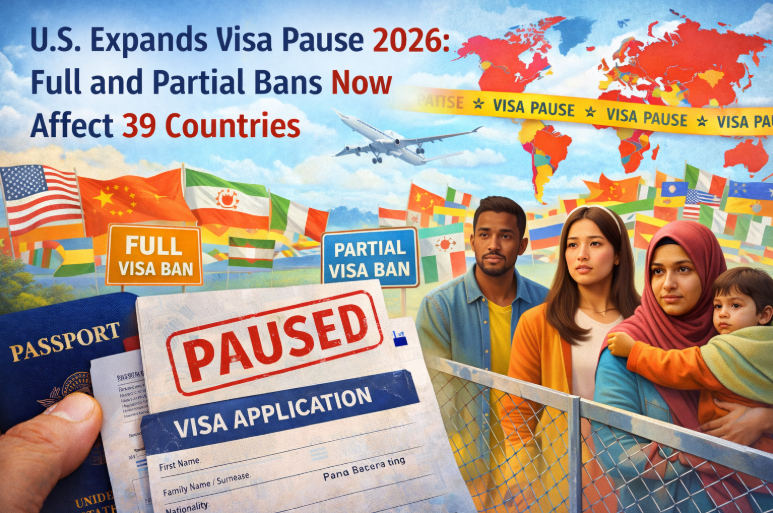
In January 2026, the United States quietly implemented one of the most significant visa policy expansions in recent years. Under Presidential Proclamation 10998, visa issuance has been fully or partially suspended for nationals of 39 countries, reshaping travel, study, work, and family immigration pathways for thousands of people worldwide.
This policy is not a blanket travel ban, nor does it cancel existing visas. Instead, it introduces a two-tier system that limits who can apply for certain U.S. visas and under what conditions. For affected individuals, understanding the difference between full suspension and partial suspension is critical.
This guide breaks down:
- What the new U.S. visa pause mean
- Which countries are affected, and how
- Who is exempt from the restrictions
- How travelers, students, workers, and families may be impacted
All information reflects official U.S. government guidance and publicly available policy notices as of January 2026.
What Is Presidential Proclamation 10998?
Presidential Proclamation 10998 is a U.S. immigration directive that restricts the issuance of visas to certain foreign nationals due to security and vetting concerns. It builds on earlier proclamations and expands the list of affected countries after a U.S. government review of identity verification systems, information sharing, and immigration compliance.
According to the proclamation, the restrictions are intended to:
- Address gaps in identity documentation
- Improve cooperation on information sharing
- Reduce national security risks
The policy relies on existing authority under the Immigration and Nationality Act (INA) and is implemented jointly by the U.S. Department of State and Department of Homeland Security (DHS).
Importantly, the proclamation does not revoke visas that were issued before January 1, 2026, and it does not automatically deny entry to lawful permanent residents.
Countries Under Full Visa Suspension
A full suspension means that both immigrant and non-immigrant visas are suspended for nationals of the listed countries unless they qualify for a specific exemption or waiver.
Countries Under Full Suspension
Nationals of the following countries are subject to near-total visa restrictions:
- Afghanistan
- Burma (Myanmar)
- Burkina Faso
- Chad
- Republic of the Congo
- Equatorial Guinea
- Eritrea
- Haiti
- Iran
- Laos
- Libya
- Mali
- Niger
- Sierra Leone
- Somalia
- South Sudan
- Sudan
- Syria
- Yemen
In addition, individuals travelling on Palestinian Authority-issued travel documents are also covered under the full suspension category.
What Full Suspension Means
- No new immigrant or non-immigrant visas are issued
- Tourist, student, work, and family visas are all affected
- Waivers are possible but granted on a limited, case-by-case basis
Countries Under Partial Visa Suspension
A partial suspension limits access to specific visa categories, rather than all visas.
Countries Under Partial Suspension
The following countries face targeted visa restrictions:
- Angola
- Antigua and Barbuda
- Benin
- Burundi
- Cuba
- Côte d’Ivoire
- Dominica
- Gabon
- The Gambia
- Malawi
- Mauritania
- Nigeria
- Senegal
- Tanzania
- Togo
- Tonga
- Turkmenistan (immigrant visas only)
- Venezuela
- Zambia
- Zimbabwe
Visa Categories Affected
For most countries in this 2nd group, the suspension applies to:
- Immigrant visas
- B-1/B-2 visitor visas
- F, M, and J visas (students and exchange visitors)
Other non-immigrant visa categories may still be issued, but approval depends heavily on consular discretion and individual circumstances.
What New Visa Curbs Mean in Real Life
For many people, the biggest concern is practical impact rather than legal language.
Existing Visas
If you already hold a valid U.S. visa issued before January 1, 2026, it is not automatically cancelled. Entry decisions still rest with U.S. Customs and Border Protection at the port of entry.
New Applications
Applicants from affected countries:
- May be unable to schedule visa interviews
- May receive refusals under the proclamation
- May face longer processing times and additional scrutiny
Students and Workers
Students from partially restricted countries may find F-1 or J-1 visa approvals significantly harder to obtain, especially for new programs. Workers seeking employment-based visas may encounter similar obstacles depending on their nationality and visa type.
Family Immigration
Family-based immigrant visas are impacted in both full and partial suspension countries. Immediate relatives are no longer automatically exempt, though waivers may still be requested.
Who Is Exempt from the Visa Restrictions?
Despite the broad scope of the policy, several groups are not affected by visa curbs.
Common Exemptions
- Lawful permanent residents (green card holders)
- Dual nationals travelling on a passport from an unaffected country
- Diplomats and official government travellers
- Special Immigrant Visa (SIV) holders
- Athletes and participants in major international sporting events
- Individuals granted a national interest waiver
These exemptions are narrowly interpreted, and applicants must meet documentation requirements to qualify.
What You Should Do Next
If you think you or your family members may be affected by the expanded visa curbs, the first step is to confirm your country’s classification and the specific visa categories impacted. Policies can change quickly, and individual circumstances matter.
Because waiver eligibility and exemptions depend on facts, many applicants benefit from professional guidance before submitting or reapplying for a visa. Reviewing official State Department updates and consulting a qualified immigration professional can help avoid costly mistakes and delays.
Get Trusted Guidance from VisaPro on Your U.S. Visa Options
The expanded visa curbs have made U.S. immigration more complex and uncertain, especially for applicants from affected countries. At VisaPro, our U.S. immigration professionals help individuals, families, students, and businesses navigate policy changes like Presidential Proclamation 10998 with clarity and confidence.
If you are unsure how these new visa restrictions apply to you, a personalized review can make all the difference. Contact VisaPro today to get accurate, up-to-date guidance based on official U.S. immigration rules and your unique situation.
Frequently Asked Questions
It is a policy under Presidential Proclamation 10998 that fully or partially suspends visa issuance for nationals of 39 countries based on security and vetting concerns.
Yes. Visas issued before January 1, 2026, remain valid unless revoked individually for other reasons.
Yes. Students from partially restricted countries may face suspension of F, M, and J visas, while students from fully restricted countries generally cannot apply without a waiver.
Family-based visas are restricted, and prior to automatic exemptions were removed. Waivers may still be requested but are discretionary.
No. The proclamation requires periodic review and may be modified if conditions in affected countries change.