USCIS has released updated guidance explaining how the $100,000 fee introduced under the September 21, 2025, Presidential Proclamation applies to certain H-1B petitions.
It applies only to new H‑1B petitions filed for workers outside the U.S. Existing H‑1B holders, extensions, and many change-of-status petitions inside the U.S. are generally exempt.
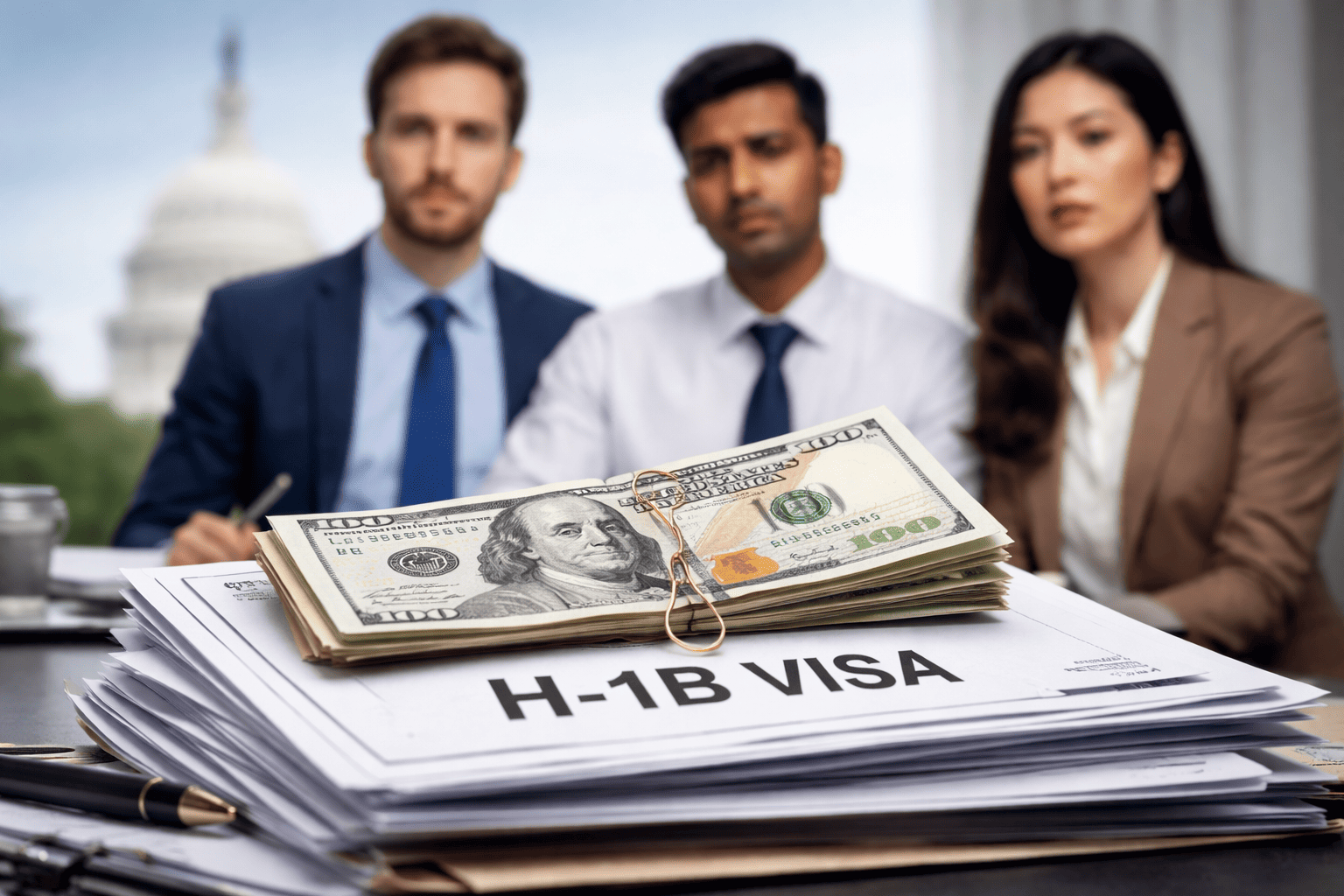
The $100,000 H-1B visa fee has sparked widespread debate. This policy change affects thousands of employers and foreign workers planning their future in America.
The fee applies to certain new H-1B petitions and has already triggered lawsuits, economic debates, and strategic changes in hiring across tech and healthcare sectors.
Key Takeaways:
- The $100K fee targets certain H-1B visa petitions, significantly increasing costs for employers.
- It has created uncertainty for skilled foreign workers planning to move to the U.S.
- Legal challenges have already been filed, signaling ongoing debate and possible policy revisions.
- Tech and healthcare sectors are adjusting hiring strategies in response to the policy.
- Employers must carefully assess costs and compliance before filing new H-1B petitions.
What Is the $100K H-1B Visa Fee and When Did It Take Effect?
The $100,000 H-1B visa fee is an additional charge imposed on certain H-1B petitions beyond standard USCIS filing fees. It is commonly called an “entry-based” fee because it applies only to new petitions for foreign nationals outside the United States seeking admission.
Standard H-1B fees typically range from a few thousand dollars, depending on the employer and petition type. The new $100K fee dramatically increases the total cost of sponsoring a worker from abroad. It is not a blanket fee on all H-1B filings.
The $100K H-1B visa fee is enacted under the following legal provisions:
- Immigration and Nationality Act (INA) §214(c)(2) – Governs H-1B visa classification and conditions of admission.
- Presidential Proclamation 10232 (Sept 19, 2025) – Authorizes the fee as a measure restricting the entry of certain nonimmigrant workers.
- 8 CFR §214.2(h) – USCIS regulations governing fees and H-1B petition procedures.
These legal references establish both the scope and enforcement authority of the fee.
Who Must Pay the $100,000 H-1B Visa Fee and Who Is Exempt from It?
Understanding who must pay the $100,000 H-1B fee is critical for both employers and prospective H-1B workers.
Cases Where the $100K Fee Applies
The fee primarily affects:
- New H-1B petitions for workers outside the United States: If you’re applying for an H-1B visa while residing abroad, this fee applies to entry-based petitions.
- Cases requiring visa stamping: Workers who need to obtain H-1B visa stamps at U.S. consulates abroad fall under this requirement.
- Cap-subject H-1B petitions: First-time H-1B applicants entering through the annual lottery system.
Situations Where the Fee Does Not Apply
Several H-1B visa exemptions 2026 provide relief:
- H-1B extensions inside the U.S.: Current H-1B holders extending their status without leaving the country are exempt.
- Change of status petitions: F-1 to H-1B transitions processed entirely within the United States avoid this fee.
- H-1B transfers between employers: Job changes while maintaining H-1B status domestically don’t trigger the fee.
- Possible national interest exemptions: Certain healthcare workers and researchers may qualify for waivers, though specific criteria remain under development.
| Scenario | $100K Fee Required? |
|---|---|
| New H-1B (worker outside U.S.) | Yes |
| H-1B extension (worker in U.S.) | No |
| F-1 to H-1B change of status | No |
| H-1B transfer (same status) | No |
| Re-entry after travel abroad | Yes (if new petition) |
This distinction is crucial for immigration compliance and strategic planning.
Why Was the $100K H-1B Visa Fee Introduced?
Supporters of the policy argue that it serves several purposes:
- Protecting U.S. workers
- Discouraging misuse of the H-1B program
- Reducing dependency on foreign labor
- Increasing government revenue
The broader policy narrative focuses on tightening employment-based immigration pathways and reducing perceived system abuse.
Critics, however, argue that the H-1B system is already heavily regulated and that such a high fee may distort hiring decisions rather than solve structural labor concerns.
Federal Court Decisions: Has the $100,000 H-1B Fee Been Blocked or Upheld?
The $100K H-1B visa fee has faced significant legal challenges since its implementation. In October 2025, multiple business groups, including the U.S. Chamber of Commerce, filed federal lawsuits arguing that the fee exceeded executive authority and was unlawful under U.S. immigration law.
The lawsuits aimed to halt the fee enforcement and protect employers from the sudden financial burden of sponsoring foreign workers.
Federal courts have rejected efforts to permanently block the fee, allowing it to remain in effect for qualifying new H-1B petitions. Legal challenges continue, but enforcement proceeds, meaning employers sponsoring foreign workers from abroad must comply with the $100,000 fee requirement.
Key points:
- Lawsuits filed: October 2025 by employer coalitions
- Court decisions: Fee upheld while litigation proceeds
- Practical effect: Fee remains active for new petitions outside the U.S.
Economic Impact of the $100K H-1B Fee on U.S. Employers and Global Companies
The impact of $100K H-1B fee on tech companies and other sectors has been substantial and multifaceted.
Impact on Tech Companies and Startups
Silicon Valley and the broader tech industry face increased hiring costs, averaging $100,000 per foreign worker before considering salaries, relocation, and legal fees. For startups with limited capital, this represents a prohibitive barrier.
Many companies are shifting hiring strategies toward:
- Building offshore teams in countries with robust tech talent
- Increasing salaries for U.S.-based workers to attract domestic talent
- Exploring alternative visa categories
- Delaying or cancelling expansion plans requiring specialized foreign expertise
Impact on Healthcare and Foreign Doctors
Rural healthcare facilities face particularly acute challenges. Areas already experiencing physician shortages now struggle to recruit foreign doctors, many of whom come from India and other countries through H-1B programs.
Several lawmakers have raised concerns that this policy undermines healthcare access in underserved communities, potentially creating public health risks. The national interest exemption discussions focus heavily on this sector.
What the $100K H-1B Fee Means for Foreign Workers Planning to Apply in 2026
If you are outside the United States, your employer may face the $100K H-1B visa fee when filing your petition. This could affect sponsorship willingness.
If you are already inside the United States, most renewals, extensions, and transfers are not subject to the $100K fee. International students transitioning from F-1 to H-1B within the U.S. are generally not impacted by the entry-based fee structure.
What employers are likely to do: Companies will be more selective, prioritizing candidates with exceptional qualifications. Some may negotiate longer commitment periods to justify the investment.
Should candidates delay or reconsider plans? If you’re abroad, weigh whether your skills justify the high $100K H-1B fee for employers. You might also consider alternative paths, such as pursuing a U.S. education first, before applying for an H-1B.
Can the $100,000 H-1B Visa Fee Be Reversed, Modified, or Extended in the Future?
Is the $100K H-1B fee permanent? The realistic answer involves multiple scenarios.
- Court challenges: Ongoing lawsuits could overturn the fee if courts rule it exceeds presidential authority. Still, a full reversal seems unlikely in the short term.
- Congressional action: Congress could pass a law to limit or remove the fee. This would need bipartisan support and the president’s approval, which is difficult in the current political climate.
- Future administrations: A new administration could change or remove the fee through a Presidential Proclamation. This is the most likely way for major changes, but it depends on election outcomes.
The fee will probably stay in place through 2026. Any changes are more likely to be partial, such as additional exemptions or gradual reductions, rather than complete removal.
Alternative Visa Options Employers May Consider If the $100K H-1B Fee Continues
| Alternative Visa Option | Description / Benefits |
|---|---|
| L-1 Visa | For multinational companies, intracompany transferees can avoid the $100K H-1B fee. Ideal for employees with at least one year of experience at a foreign affiliate. |
| O-1 Visa | For individuals with extraordinary ability in the sciences, arts, business, or athletics. No annual caps or lottery, though qualification standards are high. |
| Remote Hiring / Global Workforce | Companies hire employees in their home countries and collaborate digitally. Eliminates visa costs. |
| Cap-Exempt H-1B Strategies | Positions at universities, research institutions, and nonprofit research organizations may be exempt from the fee and annual cap. Employers should consult immigration attorneys for guidance. |
Frequently Asked Questions (FAQs)
Only if you’re applying for a new H-1B petition while outside the United States or requiring entry-based approval. Current H-1B holders extending status domestically do not pay this fee.
No. H-1B extensions for workers already in the United States on H-1B status are exempt from the $100,000 fee.
No. Immigration law generally prohibits employers from requiring employers to pay visa petition fees. The employer must bear this cost.
Details on refund policies remain unclear. Typically, if a petition is denied, fee refund procedures depend on specific DHS regulations, which are still being clarified for this new fee structure.
The fee applies to the primary H-1B petition. H-4 dependent visas have separate, much lower fees, though dependents cannot enter if the primary applicant hasn’t paid the required fees.
The fee took effect in early 2025 following the Presidential Proclamation, with immediate implementation of new petitions.
Workers changing status inside the U.S., H-1B extensions, employer transfers, and potentially certain national interest cases receive exemptions.
No. While legal challenges continue, courts have not blocked the fee implementation. It remains in effect.