Losing your job on an H-1B visa puts you on a strict legal clock. Under current USCIS rules, most H-1B workers get a 60-day grace period after termination to take action. During that time, you must either transfer your H-1B, change status, or leave the United States. If you do nothing, you risk falling out of status and triggering long-term immigration penalties.
Key Takeaways
- The H-1B grace period is up to 60 days, but it can end earlier if your I-94 expires.
- Filing Form I-129 before the deadline protects your status under the portability rule.
- A backup Form I-539 filing can help if you don’t secure a job in time.
- An unlawful presence starts after you fall out of status and can trigger 3- or 10-year bans.
- Acting within the first 2 weeks significantly improves your chances of staying legally.
- A rejected or late filing does not protect your status.
- Your I-94 date is just as important as your grace period timeline.
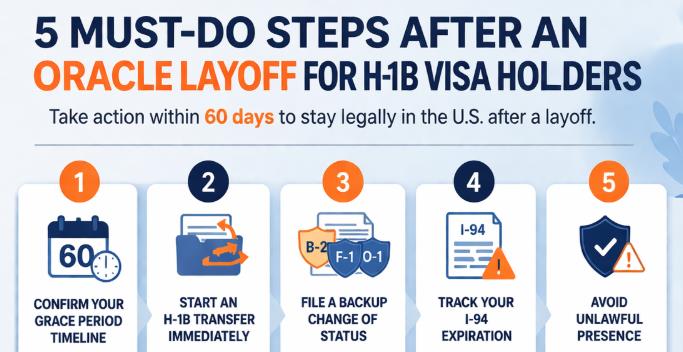
Step 1: Confirm Your Exact Grace Period Timeline (It’s Not Always 60 Days)
The 60-day grace period is set out in 8 CFR 214.1(l)(2). But here’s what most people miss: it is not always a full 60 days.
Your grace period ends at the earlier of:
- 60 days after termination, or
- Your I-94 expiration date
In our practice, we’ve seen people assume they had 60 days, only to discover their I-94 expired in 18 days. That mistake alone can push someone out of status.
Here’s how to calculate your real deadline:
- Find your termination date (last payroll date or official notice)
- Check your I-94 online from CBP
- Use the earlier of the two dates
One thing that surprises many clients is that USCIS does not “extend” your stay automatically just because you were laid off. The grace period is limited protection, not guaranteed.
Step 2: Start an H-1B Transfer Immediately
The fastest way to stay in the U.S. is to file an H-1B transfer with a new employer.
You can start working for a new employer as soon as they file Form I-129, as long as:
- The petition is filed before your grace period ends
- You were in a valid status at the time of filing
Here’s what we see often: people wait until they have multiple job offers or try to negotiate terms first. That delay can cost them legal status.
In reality, timing matters more than perfection. Filing early protects you.
What Most Employers Get Wrong About Transfers
A common issue we encounter is incomplete or delayed filings. Employers sometimes:
- Wait for full documentation before filing
- Miscalculate the grace period
- Assume premium processing is required
It isn’t.
A properly filed I-129 within the grace period is what protects your status. Even if USCIS takes months to process it, your stay is authorized while it’s pending.
Step 3: File a Backup Change of Status (B-2, F-1)
Relying only on a job search is risky. If you don’t secure a job in time, you need a fallback.
That’s where Form I-539 comes in. You can apply for:
- B-2 (visitor status)
- F-1 (student status)
In our experience, filing a B-2 as a backup is common. It can give you additional time to stay while continuing your job search.
But this strategy has limits.
B-2 Strategy: When It Works and When It Fails
USCIS expects B-2 applicants to show temporary intent. If your application clearly shows you are only staying to find a job, it may be questioned.
Step 4: Track Your I-94 Expiration
Your I-94 controls your authorized stay in the U.S.
Even if you think you have time under the grace period, your I-94 can cut it short.
Here’s a real scenario we see:
- The worker was laid off with 60 days expected
- I-94 expires in 20 days
- No filing made before the I-94 expiry
- Result: out of status after day 20
That’s why this step is critical.
Check your I-94 immediately and plan everything around that date. Not doing this is one of the fastest ways to lose status.
Step 5: Avoid Unlawful Presence Triggers (This Is Where Most People Fail)
Unlawful presence begins when you remain in the U.S. without authorization.
180+ days of unlawful presence = 3-year bar
365+ days = 10-year bar
Here’s what we see often:
- People assume they’re safe while job hunting
- They filed after the deadline
- Or their application gets rejected due to errors
If your petition is denied and you have no underlying status, an unlawful presence can start immediately.
One thing to watch for: a rejected filing (not accepted by USCIS) does not protect your status. Only a properly filed case does.
Common Mistakes That Can Get You Out of Status
A few patterns show up repeatedly:
- Not checking the I-94 expiration date and relying only on the grace period
- Delaying employer sponsorship discussions until the grace period is nearly over
- Assuming premium processing is mandatory and waiting unnecessarily to file
- Submitting incomplete or incorrect Form I-129 petitions
- Missing signatures or required supporting documents in filings
- Ignoring requests for evidence (RFEs) or responding late to USCIS
- Starting work with a new employer before a proper petition is filed
- Failing to maintain a record of the termination notice or the last working day
- Overestimating job search timelines without a backup plan
- Not consulting an immigration attorney when circumstances are unclear
- Relying on unofficial advice instead of verified USCIS guidance
- Filing a change of status without ensuring eligibility criteria are met
Each of these can lead to loss of status.
Talk to VisaPro Before Your Deadline Runs Out
Losing your H-1B job puts you on a strict timeline, and every day counts. A small delay or wrong filing can affect your legal status in ways that are hard to fix later.
VisaPro’s immigration attorneys can review your situation, calculate your exact deadline, and guide you on the fastest and safest option.