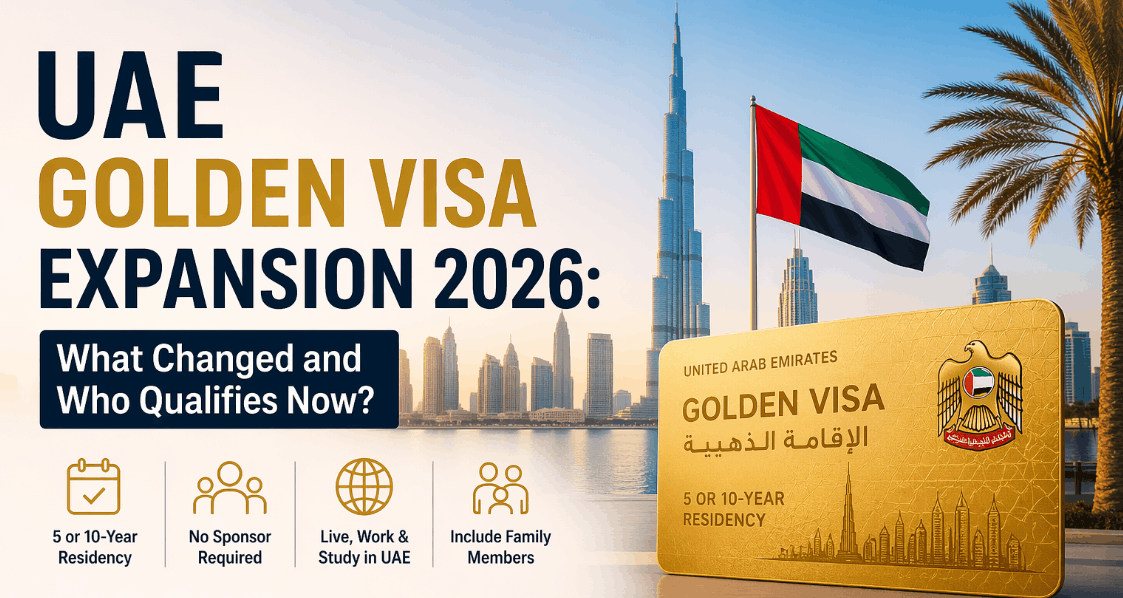
The UAE Golden Visa expansion 2026 has changed how long-term residency works across the country. It now includes skilled professionals, entrepreneurs, students, and digital creators alongside investors. The system supports self-sponsored residency in the UAE, offers more flexibility under the UAE property visa, and strengthens long-term family stability.
At its core, this update shifts the focus from investment alone to skills, contribution, and long-term value. If you meet the right criteria, you can now qualify without relying on an employer or large capital.
Key Takeaways
- The UAE Golden Visa expansion 2026 introduces multiple new eligibility categories
- The system now supports a talent-based visa UAE approach alongside investment
- Property rules are more flexible, especially for financed investments
- Family sponsorship now allows for more stable long-term residency
- Digital systems have improved application speed and accessibility
- The UAE is focusing on long-term talent retention, not just short-term workers
This article is for general informational purposes only and does not constitute legal advice. Immigration policies may change, and eligibility varies by individual case. Always confirm details with official UAE government sources before applying.
What Changed in the UAE Golden Visa Expansion 2026?
The UAE immigration reforms 2026 introduced a broader and more flexible system. Instead of focusing only on investment, the government expanded eligibility to include people who contribute through expertise, innovation, or long-term presence.
The 2022 overhaul first expanded Golden Visa eligibility to professionals and other categories. The 2025-2026 updates further added nurses, teachers, content creators, e-sports professionals, and Waqf donors, and removed the 50%/AED 1M upfront-payment rule for property investors.
A Shift Toward Talent and Skills
The biggest change is the expansion into a global talent visa UAE framework. Professionals in sectors like technology, healthcare, education, and engineering now have clearer pathways.
Roles such as AI specialists, data scientists, doctors, and researchers fall into priority categories. This aligns with the country’s long-term goal of building a knowledge-driven economy.
What matters now is not just how much you invest, but how your work fits into high-demand sectors.
Property Investment Is More Flexible
The UAE property visa route remains important, but the rules are easier to meet. Investors can now qualify with mortgaged properties or structured payment plans in many cases. Off-plan projects are also gaining acceptance, which was previously a grey area.
This change lowers the barrier for investors who do not want to commit full capital upfront.
Family Sponsorship Has Expanded
One of the most practical updates is the expansion of family benefits. The Golden Visa now supports long-term residency for spouses and children with fewer restrictions.
In many cases, no upper age limit for sponsored children under specified conditions, and families can stay together without frequent renewals. This makes the visa more suitable for people planning to settle in the UAE long-term.
Growth of Self-Sponsored Residency
The expansion of residency without sponsor UAE is a major shift. Professionals and freelancers can now apply independently instead of relying on an employer.
This creates flexibility. Changing jobs or working remotely no longer puts residency at immediate risk. For many professionals, this is one of the most valuable changes in the system.
Faster, Digital Application Process
Applications are handled through ICP federally, through GDRFA in Dubai, and DLD for property-based Dubai applications.
While timelines still vary depending on the case, approvals are generally faster compared to previous years. This reflects the UAE’s broader move toward digital government services.
Before vs After: What Actually Improved?
| Feature | Before 2026 | After 2026 |
|---|---|---|
| Eligibility | Mostly investors | Investors, professionals, creators |
| Investment Rules | Strict structure | Flexible financing options |
| Sponsorship | Employer-dependent | Self-sponsored pathways |
| Family Benefits | Limited | Expanded long-term coverage |
| Application Process | Slower | Digital and faster |
Who Can Apply Now?
The expanded system includes several entry points, each designed for a different profile.
Skilled Professionals
Professionals are one of the biggest beneficiaries of the UAE Golden Visa expansion 2026. Eligibility usually depends on qualifications, salary level, and whether the role falls within priority sectors.
Fields such as healthcare, engineering, and technology are strongly represented. A data analyst working in AI or a doctor in a specialized field has a much clearer path today than a few years ago.
This reflects the UAE’s effort to attract and retain high-value skills under its UAE workforce policy.
Entrepreneurs and Startup Founders
The Golden Visa now supports individuals building businesses, not just those investing in existing ones. Entrepreneurs can qualify if their startup meets certain innovation or growth criteria.
Approval often depends on recognition from relevant UAE authorities or incubators. This category is designed to support long-term economic diversification.
Real Estate Investors
Investors remain a central part of the program, but the pathway is no longer limited to property alone. The AED 2 million real estate threshold still applies, and recent flexibility in financing has made it more accessible.
At the same time, investors can now qualify through multiple routes, including an AED 2 million investment in an approved UAE investment fund, ownership or partnership in a UAE-based company generating at least AED 2.5 million in annual revenue, or demonstrating a minimum of AED 250,000 per year in tax contributions to the UAE government.
This route is still one of the most direct ways to qualify, especially for those already planning to invest in UAE real estate.
Students and Graduates
High-performing students now have a clear pathway to long-term residency with defined academic benchmarks
High school students must achieve at least 95% in UAE secondary schools to qualify. For higher education, university students and graduates need a minimum GPA of 3.5 from UAE universities or 3.8 from top-ranked global universities, based on approved ranking criteria.
This structured eligibility helps retain top academic talent and reduces the need for students to leave the country after graduation.
Digital Creators and Freelancers
A newer category includes digital professionals such as content creators, designers, and independent media specialists.
This reflects the growth of the digital economy and aligns with broader innovation visa UAE trends. It also supports freelancers who work with international clients but want a stable base in the UAE.
Why the UAE Expanded the Golden Visa
The country is focusing on sectors like technology, healthcare, and research to build a sustainable economy.
To support this shift, the UAE needs long-term residents who contribute through skills and innovation. The Golden Visa is now a key tool for attracting and retaining that talent.
It also reduces reliance on short-term work visas, which can create instability for both individuals and businesses.
Is It Easier to Get the Golden Visa Now?
The eligibility criteria have expanded, which may create new pathways for some applicants depending on their individual circumstances.
Professionals in high-demand sectors have a clearer path than before. Freelancers and remote workers also benefit from the expansion of self-sponsored residency in the UAE.
Requirements still apply, and documentation must clearly support eligibility. Investment routes still require financial commitment, and professional categories depend on qualifications and experience.
How to Apply for the UAE Golden Visa in 2026?
The application process has been streamlined digitally, though requirements remain detailed and case specific. Careful preparation is still important.
Start by identifying the correct eligibility category. This step is important because requirements vary depending on whether you apply as an investor, professional, or entrepreneur.
Next, gather all required documents. These usually include a valid passport, proof of qualifications or employment, and financial or investment evidence where applicable.
Applications are submitted through Federal Authority for Identity, Citizenship, Customs & Port Security UAE or other relevant government platforms. After submission, authorities review the case and may request additional information before approval.
Processing time depends on the category, but digital systems have reduced delays in many cases.
Common Mistakes That Affect Approval
One common issue is applying under the wrong category. Many applicants assume they qualify as investors or professionals without checking the exact criteria.
Incomplete documentation is another frequent problem. Missing financial proof or unclear qualification records can delay or affect approval.
Property investors sometimes miscalculate eligibility, especially when dealing with financing or shared ownership. It is important to ensure the total value meets the required threshold.
Staying updated with the latest rules is also important, as requirements can change over time.
Frequently Asked Questions
The UAE Golden Visa expansion 2026 refers to updated rules that allow more categories, such as professionals, freelancers, and creators, to apply. It also includes more flexible investment and residency options.
Investors, skilled professionals, entrepreneurs, students, and digital creators can apply if they meet the updated eligibility criteria. Each category has its own requirements based on skills or investment.
Property investment is one of the options, but not the only one. Skilled professionals and other eligible groups can apply without buying real estate.
The visa is generally issued for 5 or 10 years, depending on the category. It can often be renewed if eligibility conditions are still met.
Yes, family sponsorship rules allow spouses and children to stay for longer periods. The system is designed to support family stability in the UAE.
The 2026 update expands eligibility beyond investors to include talent-based categories. It also introduces more flexible residency and faster digital processing.
Many professionals can apply without an employer sponsor under the self-sponsored residency model. This gives more independence compared to traditional work visas.
Most applications are handled through official UAE digital platforms. The process is more streamlined compared to earlier years, with fewer manual steps.
The expansion is part of the UAE’s effort to attract global talent and strengthen key sectors. It supports long-term economic growth and innovation-focused development.