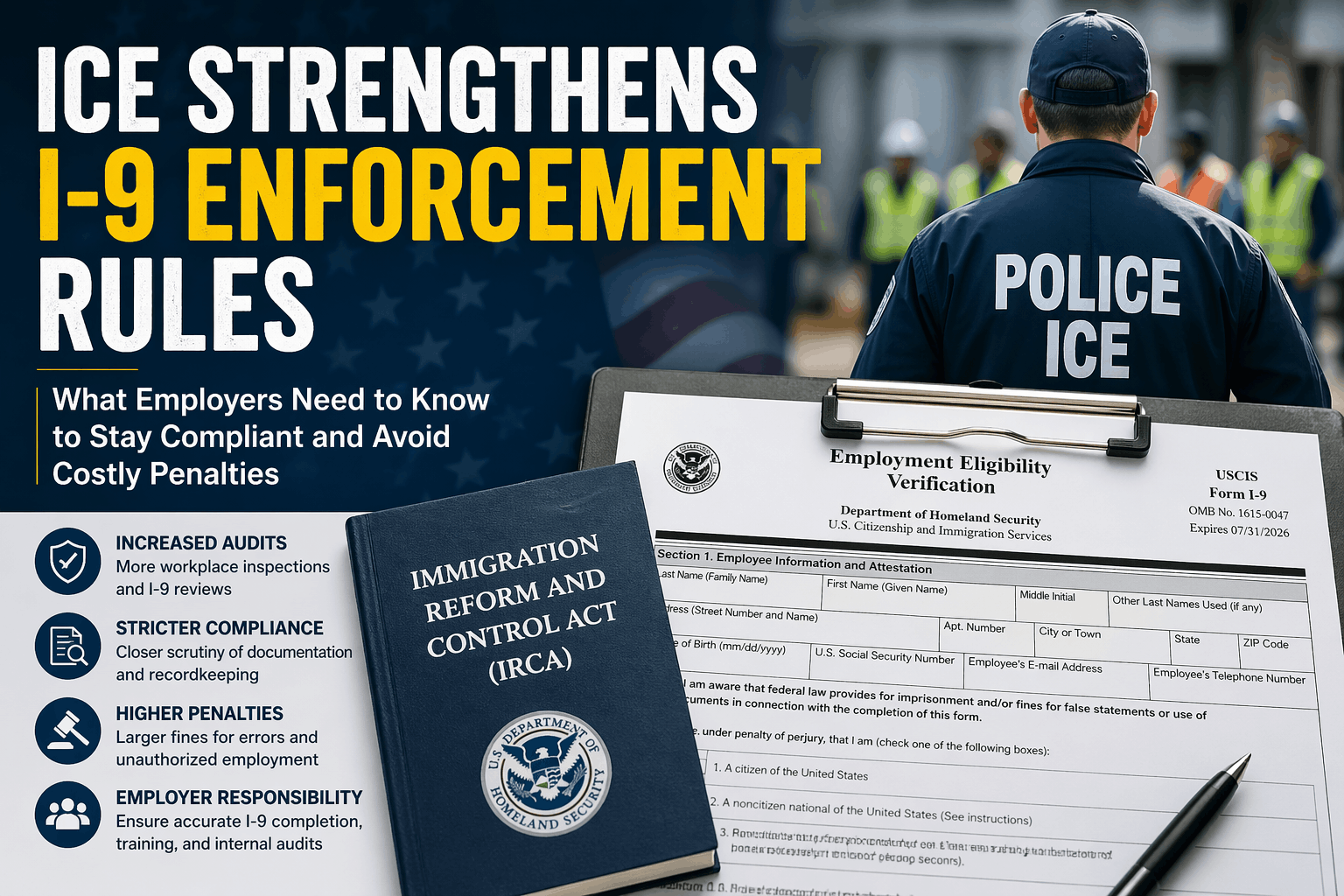
ICE I-9 enforcement rules refer to the federal framework used by U.S. Immigration and Customs Enforcement (ICE) to verify whether employers are properly completing and retaining Form I-9 records for every hired employee.
These rules sit under the Immigration Reform and Control Act (IRCA) and give ICE authority to inspect hiring records, conduct audits, and issue penalties when violations are found.
In practical terms, ICE enforcement does not begin with physical workplace action. It starts with paperwork review. Employers receive a Notice of Inspection and must submit hiring records within a strict timeframe. From that point, ICE evaluates every Form I-9 entry for compliance errors, missing documents, and inconsistencies.
Key Takeaways
- ICE issues Notice of Inspection requiring employers to submit Form I-9 records within three business days
- Substantive violations, such as missing work authorization documents
- ICE calculates fines based on violation type, Size of the business, and prior compliance history
- Employers must maintain Form I-9 records under IRCA and 8 CFR 274a requirements
- Failure to respond on time can escalate enforcement before a full review
- Internal audits significantly reduce exposure to ICE enforcement actions
This article is for general informational purposes only and does not constitute legal advice. Immigration law is fact-specific, and outcomes may vary depending on individual circumstances. Consult a licensed immigration attorney for guidance on your case.
What ICE I-9 Enforcement Rules Actually Mean for Employers
ICE I-9 enforcement rules come from federal employer sanction laws under the Immigration Reform and Control Act (IRCA). This law requires every U.S. employer to verify that each employee is legally authorized to work in the United States by completing Form I-9.
The enforcement authority is shared between DHS agencies, primarily ICE and USCIS. USCIS provides the form and guidance, while ICE handles audits and enforcement actions. This separation is important because many employers assume Form I-9 is only a hiring form. In reality, it becomes a legal compliance document that can be reviewed years after hiring.
Employers are required not only to collect identity and work authorization documents but also to retain them for inspection. ICE can review these records without needing employee consent.
The enforcement system focuses on three core areas:
- Whether Form I-9 was completed correctly at the time of hire
- Whether documents were properly verified and recorded
- Whether records are retained and accessible during audits
Even small errors such as missing dates or incomplete sections can become compliance issues during inspection
2026 ICE Update: More I-9 Errors Now Lead to Immediate Fines
On March 16, 2026, U.S. Immigration and Customs Enforcement tightened Form I-9 enforcement. Errors that were previously fixable are now treated as substantive violations, meaning employers can be fined right away.
Key errors now considered serious:
- Missing employee date of birth in Section 1
- Missing USCIS number (if required)
- No date next to employee signature
- Missing expiration date in Section 1
- Using Spanish I-9 outside Puerto Rico
- Missing employer name or title in Section 2
Employers can no longer rely on fixing errors during audits. Forms must be accurate at the time of hiring. Even small gaps in Section 1 can now trigger penalties.
Step-by-Step ICE I-9 Audit Process (What Actually Happens)
ICE audits follow a structured legal process and may involve unannounced action at the worksite.
Step 1: Notice of Inspection (NOI)
ICE issues a Notice of Inspection requiring the employer to produce Form I-9 records and supporting documentation. This notice typically gives only three business days to respond. The employer must gather all requested records quickly, which often includes current and past employee files.
Step 2: Document Submission Window
Employers submit:
- Form I-9 records for active and terminated employees
- Payroll lists
- Business entity documentation if requested
In many cases, this stage exposes the first compliance gaps. Missing or incomplete forms are flagged immediately.
Step 3: ICE Review and Classification
ICE agents review each Form I-9 entry and classify errors into two categories:
Technical errors are minor and may allow correction. These include missing fields or formatting issues.
Substantive violations are more serious. These include failure to verify work authorization or missing required documentation.
This classification stage determines whether penalties will follow.
Step 4: ICE Notices Issued After Inspection (What Employers Actually Receive)
After reviewing submitted records, ICE does not issue a generic “Notice of Findings.” Instead, it sends one or more specific notices based on what was identified during the inspection.
If no violations are found, the employer receives a Notice of Inspection Results, often referred to as a compliance letter. This confirms that records meet federal requirements.
When issues are identified, ICE may issue different types of notices depending on the severity:
- A Notice of Technical or Procedural Failures is issued for correctable errors. Employers are given at least 10 business days to fix these issues, as required under INA § 274A(b)(6)(B).
- A Notice of Discrepancies is sent when employee work authorization cannot be confirmed based on available records.
- A Notice of Suspect Documents indicates that certain employees may not be authorized to work, placing responsibility on the employer to take corrective action.
- A Warning Notice is issued for substantive violations where ICE expects future compliance but does not impose immediate fines.
- A Notice of Intent to Fine (NIF) is issued in more serious cases, including uncorrected violations, missing I-9 forms, or evidence of knowingly hiring unauthorized workers.
This stage is where enforcement risk becomes concrete. Penalties, if issued, are typically calculated per violation and can expand if patterns of non-compliance are identified across the workforce.
ICE I-9 Penalties and Employer Liability Structure
ICE penalties are not random. They follow a structured calculation system based on violation type, intent, and repeat history.
Penalties increase when violations involve:
- Multiple employees
- Prior audit history
- Evidence of willful non-compliance
A missing authorization document is treated differently than a simple clerical error.
Another important factor is intent. If ICE determines that an employer knowingly hired unauthorized workers or ignored verification requirements, penalties escalate sharply.
The financial impact is not limited to fines alone. Employers also face operational disruption, HR restructuring, and in some cases, monitoring requirements for future hiring.
Common Triggers That Lead to ICE Audits
ICE audits are often triggered by compliance signals rather than random selection. These patterns are frequently seen in enforcement actions.
Common triggers include:
- Sudden increases in hiring within a short period
- Inconsistent or incomplete Form I-9 records
- Mismatch between payroll data and authorized workforce records
- E-Verify inconsistencies or repeated verification failures
- Tips or complaints submitted to federal authorities
One thing that stands out in enforcement patterns is that audits often begin with documentation irregularities rather than workplace inspections.
Employers using DHS-authorized remote examination must comply with E-Verify or other authorized alternative procedure requirements, including marking the alternative procedure box when required.
Employer Response Timeline During ICE Audit
Once a Notice of Inspection is issued, timing becomes critical. Employers typically have only three business days to produce records. The governing baseline is at least three business days; employers should not assume additional time will be granted
Failure to meet deadlines can escalate the case before review even begins. ICE may proceed with findings based on incomplete submissions.
During this stage, internal coordination between HR, legal counsel, and compliance teams becomes essential. Records must be accurate, complete, and consistent across all employee files.
Technical vs Substantive I-9 Violations Explained
Form I-9 violations are divided into two categories, and this classification directly affects penalties.
Technical violations include issues like:
- Missing middle names or minor data errors
- Incorrect formatting
- Incomplete fields that can be corrected later
Substantive violations include:
- Failure to verify identity or work authorization
- Missing Form I-9 entirely
- Accepting invalid documentation
Substantive violations are treated as direct compliance failures under federal law. ICE does not always allow correction in these cases, especially if patterns suggest systemic issues.
How Employers Can Reduce ICE Audit Risk
Most enforcement issues are preventable through internal compliance systems rather than reactive corrections.
Employers with lower audit risk typically maintain:
- Regular internal I-9 audits conducted quarterly or annually
- Centralized document storage systems for employee records
- Standardized onboarding procedures across all departments
- Training programs for HR teams handling employment verification
- Cross-check systems between payroll and immigration records
In our experience, companies that treat Form I-9 as an ongoing compliance system rather than a hiring checklist face fewer enforcement actions.
ICE Enforcement Trends in 2026
ICE updated its Form I-9 inspection fact sheet on March 16, 2026, expanding listed substantive violations and clarifying technical failures. There is a stronger emphasis on cross-agency data comparison between DHS systems, E-Verify databases, and employer records.
Another trend is increased scrutiny of remote and hybrid employment records. Employers are expected to maintain consistent verification standards regardless of employee work location.
These changes reflect a shift toward structured compliance enforcement rather than isolated workplace inspections.
Frequently Asked Questions
Form I-9 is used by U.S. employers to verify the identity and employment authorization of every worker hired in the United States. It is required under the Immigration Reform and Control Act (IRCA). Failure to properly complete or retain I-9 forms can result in penalties from ICE.
On March 16, 2026, ICE updated its Form I-9 inspection fact sheet and listed additional failures as substantive violations rather than technical/procedural failures.
Businesses with large workforces, high employee turnover, or past compliance issues face higher audit risk. Industries like construction, hospitality, and staffing agencies are especially targeted.
ICE issues a Notice of Inspection, giving employers a short window to provide I-9 forms and supporting documents. Agents then review records for errors, missing information, or unauthorized employment.
Common issues include missing signatures, incorrect dates, incomplete sections, and failure to re-verify work authorization. Even minor clerical errors can lead to penalties during audits.
Penalties vary based on severity. They can range from hundreds to thousands of dollars per violation, especially for knowingly hiring unauthorized workers or repeated documentation errors.
Employers must retain Form I-9 for three years after the date of hire or one year after employment ends, whichever is later, as required by federal law.
Yes, all employees, including remote workers, must complete Form I-9. Employers must still verify documents either physically or through approved remote verification systems if eligible.
Investigations may be triggered by employee complaints, random audits, mismatched Social Security records, or patterns of suspected unauthorized employment.
Employers reduce risk by maintaining accurate records, conducting internal audits, training HR teams, and ensuring consistent documentation practices across all hiring locations.