Quick Summary:
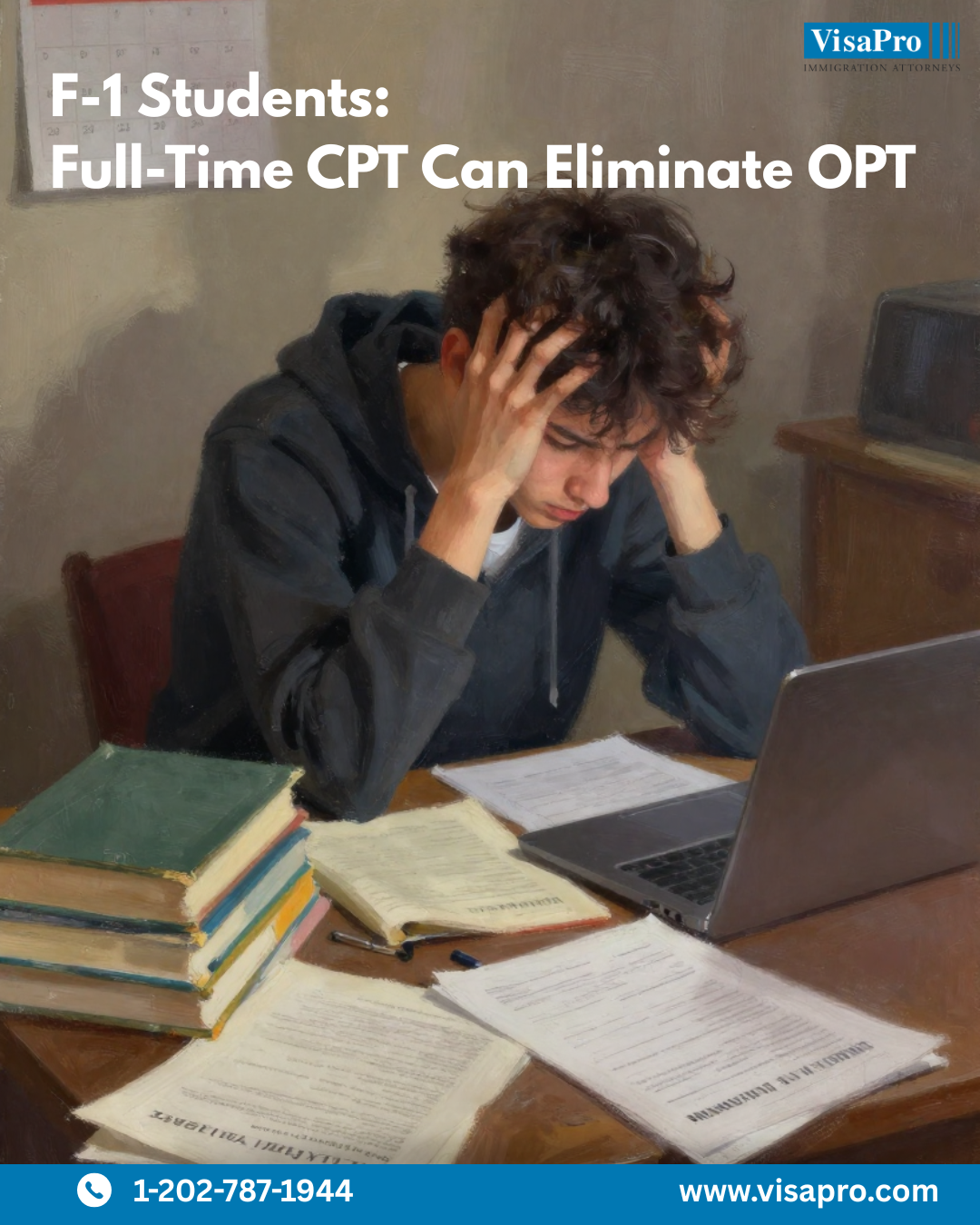
Using full-time CPT for 12 months or more eliminates your Optional Practical Training eligibility entirely- a mistake that has derailed countless international students’ career plans. Understanding the difference between part-time and full-time CPT, knowing exactly what counts toward the 12-month limit, and planning your work authorization strategically can protect your future. This guide shows you how to avoid the trap and what to do if you’re already at risk.
Understanding the CPT 12-Month Rule and Why It Matters
The rule is straightforward but unforgiving: if you use 12 months or more of full-time Curricular Practical Training (CPT), you lose all eligibility for Optional Practical Training (OPT). Part-time CPT does not count toward this limit, regardless of how many months you use it. This means you could work part-time CPT for your entire academic career without affecting your OPT eligibility.
The distinction matters enormously because OPT represents your primary pathway to post-graduation work experience in the United States. For STEM students, it can extend to 36 months, offering three full years to build your career, gain valuable experience, and potentially transition to H-1B sponsorship. Losing this opportunity due to CPT overuse represents one of the most devastating mistakes an F-1 student can make.
Full-time CPT may seem like the easiest way to gain real-world experience, especially when your academic program requires training or internship semesters. But USCIS regulations under F-1 work authorization rules are strict: the 12-month threshold is a hard stop.
The confusion often stems from how different schools calculate and approve CPT. Some designated school officials (DSOs) may not clearly explain the long-term implications. Others might approve CPT requests without discussing the cumulative effect on future work authorization. International student advisors at some institutions focus primarily on current semester compliance rather than multi-year strategic planning.
This means that even the most innocent choices, a school counselor encouraging long-term CPT, or an employer needing “just one more semester” of full-time work, can permanently eliminate your OPT prospects.
Real Student Scenarios That Show the Stakes
- Scenario 1: A computer science student takes full-time CPT for 14 months because her university’s “degree-linked” internship program requires it. She later discovers she is no longer eligible for OPT and must leave the U.S. after graduation.
- Scenario 2: A biotech student uses two summers of part-time CPT (24 months = two years). This does not count against OPT because part-time CPT is unlimited.
- Scenario 3: A business student takes 6 months part-time CPT, then switches to 6 months full-time CPT. They remain eligible for OPT because only full-time CPT is counted against the 12-month CPT limit.
If you are anywhere close to the threshold, now is the time to slow down and get clarity, before the consequences become irreversible.

Part-Time CPT Rules: Your Hidden Safety Net
Part-time CPT rules allow unlimited usage without affecting OPT in any way. Part-time CPT is defined as 20 hours or less per week and does not count toward the 12-month CPT limit.
Key point: You can use part-time CPT every semester of your degree, even for several years, and you will still retain your full OPT rights.
This is one of the most misunderstood aspects of curricular practical training.
Examples of Safe CPT Planning
| CPT Type | Hours Per Week | Counts Toward 12-Month Limit? | Impact on OPT |
|---|---|---|---|
| Full-time CPT | 20+ hours | Yes | 12+ months = complete OPT ineligibility |
| Part-time CPT | Less than 20 hours | No | No impact regardless of duration |
| Summer full-time CPT | 40 hours (typical) | Yes | Each summer = 3-4 months toward limit |
| Semester part-time CPT | 15-19 hours (typical) | No | Can continue indefinitely without OPT impact |
Understanding the distinction prevents panic and misinformation.
Why Part-Time CPT Helps Preserve Your Long-Term Plans
For students hoping to:
- work on STEM OPT
- transition to H-1B
- build U.S. experience gradually
- maintain strong academic performance
Part-time CPT becomes a powerful tool without risking immigration benefits.
Many students who thought CPT affects OPT negatively are relieved to discover that part-time CPT does not.
How CPT Affects OPT (Breaking the Myths)
CPT affects OPT only when the student uses 12+ months of full-time CPT. Any amount of part-time CPT and any amount of full-time CPT less than 12 months does not impact OPT in any capacity.
Key point: OPT is eliminated only at the 12-month full-time CPT threshold, not earlier, not based on program structure, and not because of employer pressure.
Common Myths Students Believe (And the Truth Behind Them)
Myth 1: “If I use full-time CPT for two summers, I lose OPT.”
Truth: Two summers = approx. 6 months. You are safe.
Myth 2: “My school said CPT and OPT eligibility are the same.”
Truth: OPT is a federal benefit; schools cannot override USCIS limits.
Myth 3: “Part-time CPT accumulates into full-time CPT equivalency.”
Truth: This is false. Part-time CPT is unlimited and does not combine.
Scenario: The Student Who Lost Everything
A student in California used 13 straight months of full-time CPT because:
- their employer needed 40 hours per week
- their school approved it
- they assumed OPT would still be available
When filing for OPT, USCIS issued a denial citing “more than 12 months of full-time CPT.”
One month cost them their entire post-graduation career plan.

Real-World Examples: Students Who Lost OPT Benefits
Students lose OPT eligibility when they accumulate exactly 12 months or more of full-time CPT, and the consequences are immediate and irreversible. These aren’t theoretical scenarios, they represent actual cases where career trajectories changed dramatically due to CPT miscalculation.
Case Study: The Co-op Program Trap
Raj, a computer science student, enrolled in his university’s cooperative education program. The program required alternating semesters of full-time work and full-time study. He completed:
- Fall 2021: 4 months full-time CPT
- Fall 2022: 4 months full-time CPT
- Fall 2023: 4 months full-time CPT
These three co-op semesters totaled exactly 12 months of full-time CPT. When Raj graduated in May 2024 and applied for OPT, his application was denied. He had planned to use OPT to continue with his co-op employer, who had offered him a full-time position and eventual H-1B sponsorship. Instead, he faced immediate departure from the United States within 60 days of his degree completion.
The heartbreaking aspect? Raj’s program advisor never clearly explained that the co-op structure would eliminate his OPT. The advisor focused on ensuring each semester’s CPT was properly authorized but never discussed the cumulative effect. Raj assumed his cooperative education program was designed with F-1 work authorization in mind and wouldn’t jeopardize his post-graduation plans.
Case Study: The Serial Internship Mistake
Priya pursued a master’s in business administration and took advantage of every summer internship opportunity:
- Summer 2022: 3 months full-time CPT at a consulting firm
- Summer 2023: 3 months full-time CPT at a financial services company
- Winter break 2023: 1.5 months full-time CPT with a startup
- Summer 2024: 3 months full-time CPT at a tech company
- Extended internship Fall 2024: 2 months full-time CPT
Total: 12.5 months of full-time CPT. Priya graduated in December 2024 with outstanding job offers, excellent grades, and no eligibility for OPT. Her story illustrates how “just one more internship” can destroy carefully laid plans. That fall semester extension, which seemed like a minor opportunity to finish a project, cost her 12 months of post-graduation work authorization.
Case Study: The Successful Part-Time Strategy
Compare this with Kenji’s approach. As an engineering student pursuing both bachelor’s and master’s degrees, he worked:
- Academic semesters: 15-19 hours per week (part-time CPT) for six semesters = 36 months part-time
- Summers: 40 hours per week (full-time CPT) for three summers = 9 months full-time
Despite working consistently throughout his five years of study and accumulating 36 months of part-time CPT experience, Kenji used only nine months of full-time CPT. He graduated with substantial work experience, preserved his full OPT eligibility, and secured a position with his internship employer using the standard 12-month OPT (extended to 36 months through STEM OPT).
The key difference? Strategic planning and understanding the part-time CPT rules. Kenji’s approach gave him more total work experience than either Raj or Priya while protecting his most valuable work authorization asset.
Case Study: The Transfer Student Discovery
Maria completed two years at a community college with multiple full-time CPT internships, accumulating 10 months of full-time CPT. When she transferred to a four-year university for her bachelor’s degree, her new international student advisor informed her about the 12-month limit. With only two months of full-time CPT remaining before losing OPT eligibility, Maria restructured her entire work plan around part-time CPT during semesters and carefully saved her remaining full-time CPT allowance for a critical summer internship in her final year.
This case highlights the importance of tracking your CPT usage across institutions and programs, especially for transfer students. Your cumulative full-time CPT follows you throughout your academic career in the United States.

Avoiding the 12-Month CPT Limit: Smart Strategies For F-1 Students
The best strategy to avoid the 12 month CPT limit is to plan CPT usage early, prioritize part-time CPT, and ensure full-time CPT stays well below 12 months total. Students should also verify program requirements carefully.
Key point: Once you hit 12 months, no attorney, DSO, or employer can reverse the loss of OPT.
Strategies That Actually Work
1. Shift to part-time CPT whenever possible
If your employer allows 20 hours/week, you instantly protect OPT.
2. Take full-time CPT only during official breaks
This ensures you stay far from accumulation limits.
3. Avoid back-to-back full-time semesters
Many students hit 12 months without noticing that two 6-month semesters equal the limit.
4. Protect your OPT at all costs
Remember: OPT is the most valuable F-1 work benefit, especially for STEM students seeking H-1B sponsorship.
Case Example: A Student Who Saved Their OPT Just in Time
A New York student was unknowingly heading toward 11 months of full-time CPT. After consulting an attorney, they switched to part-time CPT for the final term, preserving both OPT and STEM OPT.
It took one small schedule change to save their future.
Documentation and tracking strategies:
Maintain your own detailed spreadsheet tracking each CPT authorization period, whether it was designated part-time or full-time, the exact dates, and your cumulative total of full-time months used. Don’t rely solely on your school’s records or your memory.
Request a copy of your complete SEVIS record from your DSO before graduating. This record shows all CPT authorizations and provides documentation you’ll need when applying for OPT. Discrepancies between your recollection and the official record should be addressed immediately with your international student office.
| Scenario | Full-Time CPT Used | Time Remaining | Safe for OPT? |
|---|---|---|---|
| Three summer internships (3 months each) | 9 months | 3 months | Yes – can use up to 3 more months |
| Two co-op semesters (4 months each) + one summer (3 months) | 11 months | 1 month | Yes – can use up to 1 more month |
| Two summer internships (3.5 months each) + two co-op semesters (4 months each) | 15 months | None | No – OPT eliminated |
| Four years of part-time CPT (60 months total) + two summer internships (6 months) | 6 months | 6 months | Yes – part-time CPT doesn’t count |

When You Should Get Legal Help (Before It’s Too Late)
You should consult an immigration attorney anytime you are close to 9+ months of full-time CPT, are confused about CPT vs OPT eligibility, or suspect your university is pushing you toward unsafe CPT usage.
Key point: Attorneys cannot fix the problem after you cross 12 months. Help must come early.
Situations That Require Immediate Help
- Your employer insists on full-time CPT
- Your school requires “practicum semesters” that include full-time work
- You switched programs multiple times
- You have taken full-time CPT for 2–3 consecutive semesters
- You don’t know your exact CPT total
Why Early Legal Guidance Protects You
Immigration attorneys can:
- Review your CPT usage
- Confirm exact timeframes
- Suggest alternatives
- Protect OPT and STEM OPT plans
- Prepare backup options if you are already close to the limit
This clarity alone relieves immense stress, especially when the risks are so high
Frequently Asked Questions About CPT, OPT, and the 12-Month Rule
1.Does CPT affect OPT?
CPT affects OPT only when a student uses 12 months or more of full-time CPT. Part-time CPT does not impact OPT at all, even if used for several years. The impact depends solely on full-time usage.
2.Can part-time CPT stop me from getting OPT?
No. Under part-time CPT rules, any amount of part-time CPT, even multiple years, does not affect OPT eligibility. Only full-time CPT counts toward the 12-month limit affects OPT eligibility.
3.What is the 12 month CPT limit?
The 12-month CPT limit refers to the rule that students who accumulate 12+ months of full-time CPT lose OPT eligibility completely. This applies even if CPT was required by the school.
4.How do full-time CPT rules work?
Full-time CPT means working more than 20 hours per week. Any period of full-time CPT is counted toward the 12-month limit. Once a student crosses 12 months, OPT eligibility is lost permanently.
5.What is the difference between CPT vs OPT?
CPT is tied to your curriculum and must be part of your academic program, while OPT is a separate work authorization benefit available before or after graduation. CPT can eliminate OPT if overused; OPT does not impact CPT.
6.Can I lose OPT eligibility even if my school approved my CPT?
Yes. DSO approval does not protect you from USCIS rules. Even if your school authorized full-time CPT, you still lose OPT if you exceed 12 months of full-time usage.
7.How do CPT/OPT eligibility rules work for STEM students?
STEM students must be especially cautious. If full-time CPT crosses 12 months, they lose both regular OPT and the 24-month STEM extension. Protecting OPT is essential for future H-1B sponsorship.
8.What happens if I used full-time CPT without realizing it?
You should immediately calculate your total CPT usage and consult an immigration attorney. If you are below 12 months, there may still be time to adjust. If over, we can help you explore alternative strategies.
Reviewed By Immigration Attorney
Ancy S. Varghese is a U.S. immigration attorney with 19 years of business immigration experience at VisaPro Immigration Law Firm. She has extensive experience handling F-1 student visa matters, including visa interview preparation, §214(b) denials, SEVIS terminations, reinstatement strategies, CPT/OPT compliance, and post-arrival status violations. She regularly evaluates high-risk student profiles and counsels applicants on avoiding common interview and compliance pitfalls that can jeopardize lawful status.
Don’t Let the CPT Trap Derail Your Career, Get Expert Guidance Today
Navigating F-1 work authorization requires precision, strategic planning, and current knowledge of regulations that can change your career trajectory forever. The difference between 11 months and 12 months of full-time CPT is the difference between full OPT eligibility and permanent ineligibility, a distinction that affects years of your professional life.
VisaPro’s experienced immigration attorneys specialize in F-1 student work authorization strategy. We help international students:
- Evaluate your current CPT usage an cumulative totals
- Develop strategic work authorization plans that maximize experience while protecting OPT eligibility
- Navigate complex situations where you’re approaching the 12-month limit
- Explore alternatives if you’ve already exceeded the limit
- Coordinate with your school’s international student office for optimal outcomes
Schedule your free visa assessment today. Our team will review your specific situation, analyze your CPT history, and provide clear guidance on protecting your most valuable work authorization asset, your OPT eligibility.
Don’t make a 12-month mistake that costs you years of career opportunity. Contact VisaPro now for the expert legal support you need to navigate F-1 work authorization successfully.
Call us today or visit our website to schedule your free consultation. Your future career in the United States is too important to leave to chance.
What VisaPro Customers Are Saying
The US [B-1] Visa has always been a tough ride, and being denied a few times it makes it even worse. But thanks to VisaPro and their meticulous processing I was granted a Visa. I would like to thank you and all the people involved in making this a success. I would like to recommend VisaPro to all those who seek peace of mind and hassle free Visa processing.”
 Manas Bhat, Director Operations, First Houston Mortgage India