Quick Summary:
Missing a single post-arrival check-in email can trigger SEVIS record termination and put your F-1 status at risk. If you’ve failed to upload required documents like your I-20 or I-94 on time, you’re not alone, and there are concrete steps you can take right now to protect your ability to stay in the United States. This guide walks you through reinstatement options, compliance requirements, and how to prevent future violations.
Understanding How One Email Can Trigger F-1 Status Violation
An F-1 status violation can occur when international students fail to complete mandatory post-arrival procedures, including responding to school check-in emails and uploading immigration documents within designated timeframes. These seemingly small administrative tasks carry serious immigration consequences because they directly affect your SEVIS (Student and Exchange Visitor Information System) record, which the U.S. government uses to track your compliance with visa requirements.
When you first arrive in the United States on an F-1 visa, your school’s Designated School Official (DSO) must verify your enrollment within 30 days of your program start date. This process typically involves:
- Confirming your physical presence on campus or in the area
- Reviewing and validating your I-20 and I-94 arrival/departure record
- Updating your SEVIS record to reflect “Active” status
- Verifying your residential address in the United States
Most schools send automated emails to new international students requesting these documents and confirmation of arrival. These emails often contain specific deadlines, usually between 7 to 30 days from your program start date. When students miss these emails or fail to respond with the required documentation, DSOs may be unable to complete the registration process, leaving your SEVIS record in limbo or triggering an automatic termination.
The Chain Reaction of a Missed Check-In
Here’s what typically happens when you miss that critical email:
Day 1-15: School sends initial check-in email with document upload instructions. Email may go to spam folder, or get overlooked during the overwhelming first weeks in a new country.
Day 16-30: Follow-up reminders sent (if your school has this system). Some schools send multiple reminders; others send only one initial notice.
Day 31-60: If no response is received, your DSO cannot validate your enrollment. Your SEVIS record remains in “Initial” status rather than changing to “Active.” Under federal regulations, DSOs are required to report non-compliance.
Day 61+: SEVIS record may be automatically terminated for “failure to enroll” or “failure to maintain status.” This termination triggers a notification to U.S. Immigration and Customs Enforcement (ICE).
The devastating part? Many students only discover this problem weeks or months later when they attempt routine activities like applying for a driver’s license, seeking on-campus employment, or applying for Optional Practical Training (OPT). The DMV check, in particular, has become an unexpected wake-up call for thousands of international students because most state motor vehicle departments now verify immigration status through the SAVE federal database.
Why This Happens More Often Than You Think
International students face unique challenges during their first weeks in the United States:
- Email Overload: New students receive dozens of emails from various university departments, student organizations, and administrative offices. Critical immigration emails can easily get lost in this flood of information.
- Unfamiliarity with U.S. Systems: Students from countries where administrative processes work differently may not understand the legal significance of what appears to be a routine school email.
- Technical Issues: Email filters, spam folders, incorrect email addresses in university systems, or reliance on personal email accounts that students check less frequently.
- Cultural and Language Barriers: Email communication styles vary across cultures. Some students may not recognize the urgency in what seems like a friendly, informal message.
- Assumption of Automatic Processing: Many students assume that since they were admitted and granted a visa, their status is automatically “active” upon arrival.
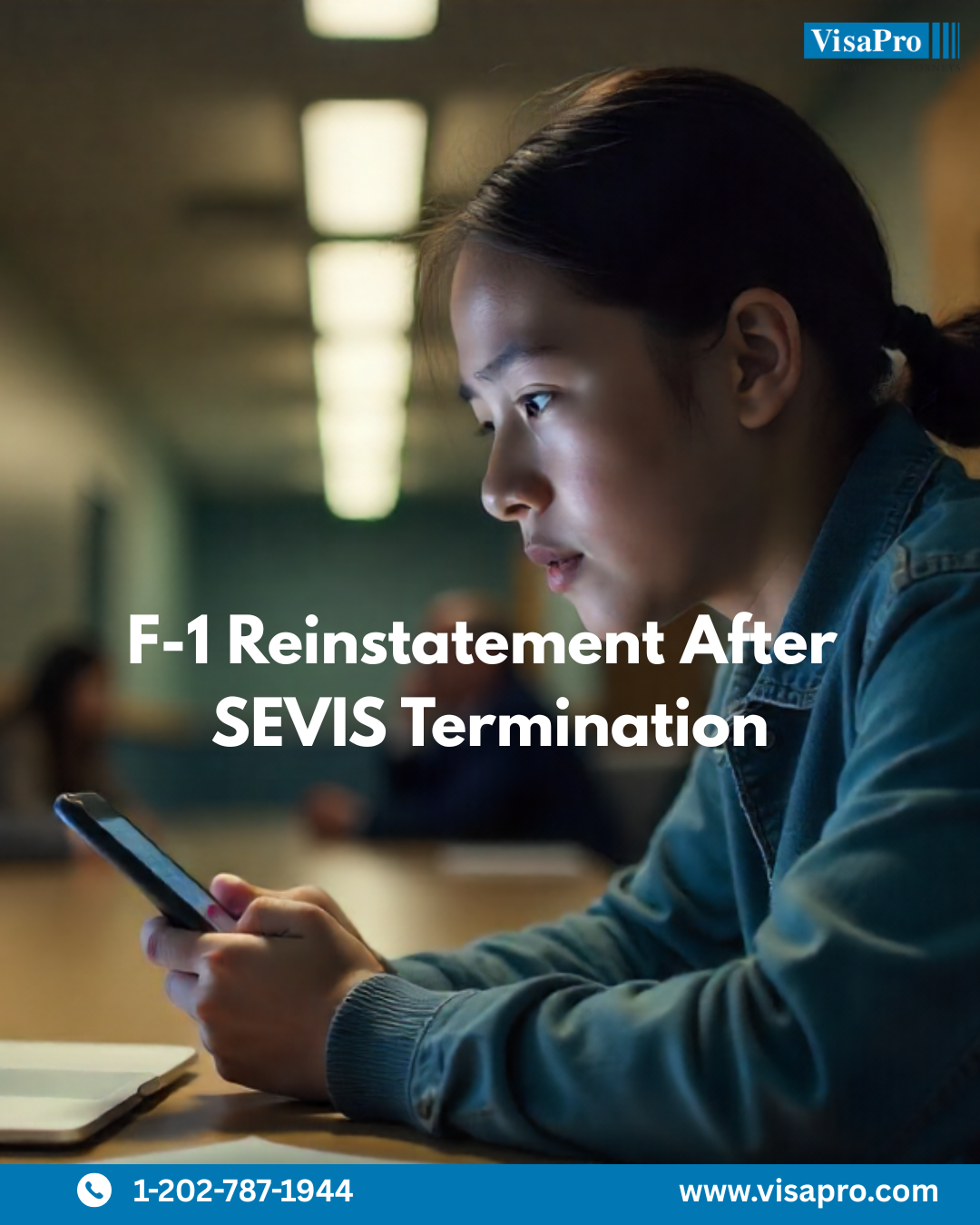
How SEVIS Termination Works: The Hidden Timeline Most Students Never See
Schools must terminate a student’s SEVIS record when they fail to follow international student check-in requirements. Termination often happens without a warning call, and students may not be notified immediately.
Most new F-1 students assume their school will send reminders or give a grace window. Many universities do… but many are legally required to terminate if deadlines are not met.
Here’s the behind-the-scenes timeline schools follow:
Day 1–3: Student Lands in the U.S.
You must complete school check-in, upload your I-20, I-94, visa page, and proof of address.
Day 5–7: Automated Email Reminders Sent
Many schools send one email. Some send two. Some send none.
Day 10–15: SEVIS Reporting Deadline Approaches
If you still haven’t checked in, the school’s Designated School Official (DSO) must either:
- Confirm your presence in the U.S., or
- Terminate your SEVIS record
Day 15–30: Termination Happens
This triggers serious consequences:
- Legal presence ends
- OPT/CPT eligibility compromised
- Reinstatement required or departure necessary
Real Scenario:
A student moved apartments during their first week and never received the school reminder. By the time she logged into the portal, her record was already terminated.
Checklist: How to Avoid This Situation
- Log in to your school portal daily for the first 2 weeks
- Add the DSO office email to safe senders
- Complete all uploads before classes start
- Attend mandatory orientation sessions
When SEVIS Record Terminated Status Destroys Your Immigration Status
SEVIS termination consequences include immediate loss of F-1 status, ineligibility to work on or off campus, inability to travel internationally and return on your F-1 visa, potential accumulation of unlawful presence, and risk of deportation proceedings. Once your SEVIS record is terminated, you are no longer legally present in the United States under F-1 status, even if you continue attending classes.
This is perhaps the most misunderstood aspect of F-1 compliance. Many students believe that as long as they’re enrolled in classes and making academic progress, they maintain legal status. This is dangerously incorrect.
The Moment Status Ends
Your F-1 status terminates the instant your SEVIS record is marked as terminated in the system—not when you’re notified, not when you discover the problem, and not when ICE takes enforcement action. This distinction matters enormously for calculating unlawful presence.
Understanding the different types of SEVIS termination:
| Termination Code | Reason | Can It Be Fixed? | Typical Scenario |
|---|---|---|---|
| No Show | Failed to enroll/check in within 30 days of program start | Yes, through reinstatement if caught within 5 months | Student missed check-in email, didn’t upload documents |
| Unauthorized Drop Below Full Course | Taking fewer credits than required without DSO approval | Yes, through reinstatement within 5 months or 15-day grace period | Dropped class without informing international office |
| Unauthorized Employment | Worked without proper authorization | Difficult; requires strong evidence of exceptional circumstances | Worked off-campus without CPT/OPT authorization |
| Withdrawal | Student officially withdrew from school | Yes, through transfer to new school or reinstatement | Student left program but wants to return later |
| Failed to Maintain Status | Violated F-1 regulations in multiple ways | Difficult; requires comprehensive reinstatement petition | Multiple violations like failing classes and working illegally |

The Moment of Shock: Discovering SEVIS Termination by Accident
Many students discover SEVIS termination consequences by accident, usually at the DMV, SSN office, or while applying for an on-campus job. Once terminated, you are officially out of status.
This is where emotions hit hardest.
Students think everything is fine, they’re attending classes, living in dorms, studying normally, and suddenly they’re told:
“Your SEVIS record is not active.”
For most, it feels like the ground disappears under their feet.
Common “Accidental Discovery” Moments
- Applying for a driver’s license
- Trying to get a Social Security Number
- Getting hired for a campus job
- Attempting to travel
- Trying to register for classes
- Getting an email about tuition but not immigration
Case Example:
An engineering student in California failed to upload his I-94 on time. He showed up at the DMV expecting a normal process, instead he learned he was out of status for 18 days.
Emotional Impact:
- Panic
- Confusion
- Shame
- Fear of deportation
- Worry about parents and future plans
Real-Life Scenario: Maria’s Driver’s License Shock
Maria arrived at a university in Texas in August 2024 to begin her Master’s program in Computer Science. During her first week, overwhelmed by orientation activities, housing logistics, and jet lag, she missed the international student check-in email. Her school sent one follow-up reminder that went to her spam folder.
Maria attended all her classes, excelled academically, and assumed everything was fine. In October, she visited the Texas DMV to apply for a driver’s license. The DMV employee ran a SAVE (Systematic Alien Verification for Entitlements) check and informed Maria that her immigration status showed as “terminated” in the federal system.
Panicked, Maria immediately contacted her international student office. Her DSO confirmed that because she never completed the check-in process, her SEVIS record had been terminated for “failure to enroll” 30 days after her program start date, eight weeks earlier. Even though Maria had been physically attending classes and earning excellent grades, in the government’s eyes, she had been out of status for two months.
The immigration clearance for students became Maria’s crisis point. Without valid F-1 status, she could not:
- Obtain a driver’s license in Texas
- Apply for on-campus employment she’d been offered
- Travel home for winter break and return on her F-1 visa
- Continue her studies legally
Maria’s case required immediate reinstatement filing, cost thousands in legal and filing fees, and took four months to resolve, during which she lived in legal limbo, unable to travel or work.
What SEVIS Termination Means for Your Future
Even if you successfully reinstate your status, a SEVIS termination can affect future immigration benefits:
- Visa renewals become more complicated: Consular officers will see the termination in your record and may question your continuing eligibility
- Change of status or adjustment applications face scrutiny: USCIS will examine why you failed to properly maintain status
- Graduate school or job sponsorship may be delayed: Background checks reveal the violation
- Permanent residence applications can be affected: Maintaining continuous lawful status is often critical for green card eligibility
This is why acting immediately when you discover a problem is essential.
Your Options Now: Reinstatement vs. Departing the U.S. and Returning
Once your SEVIS record is terminated, you typically have two choices:
- File an F-1 Reinstatement, or
- Depart the U.S. and re-enter with a new “Initial Attendance” I-20.
Choosing the right option depends on how much time has passed and the reason for your termination.
Option 1: Reinstatement (Best if You Act Fast)
USCIS may approve reinstatement if:
- You were terminated for a technical or minor violation
- You acted quickly after discovering the mistake
- You can show strong academic progress and financial capability
- You never intended to violate your status
Pros:
- No need to leave the U.S.
- F-1 continuity (OPT/CPT preserved if approved)
Cons:
- Long processing times
- Risk of denial
- Must maintain full compliance while waiting
Possible USCIS Decisions:
| Decision | What It Means | Next Steps |
|---|---|---|
| Approved | Status reinstated retroactive to termination date; you’re back in legal F-1 status | Update I-94 record; avoid future violations; eligible for benefits like OPT |
| Denied | Application rejected; begin accruing unlawful presence from denial date | Must leave U.S. immediately or file motion to reopen/appeal; consult attorney urgently |
| Request for Evidence (RFE) | USCIS needs additional documentation or clarification | Respond within deadline (usually 87 days); failure to respond = automatic denial |
Option 2: Depart and Re-enter
If too many days have passed, or if reinstatement is weak, this may be the safer route.
Pros:
- Faster return to active status
- Clean record moving forward
Cons:
- Travel cost
- Need new SEVIS fee
- OPT eligibility resets
Case Study:
A student missing her I-20 upload filed reinstatement after 5 days and was approved in 3 months.
Another student waited 60 days, attempted reinstatement, and was denied, forcing him to leave anyway.
Important:
Never stay “hoping it will resolve.” It won’t.
Real-Life Scenario: James’s Successful Reinstatement
James, a graduate student from Nigeria, had his SEVIS terminated for missing the check-in deadline due to a serious family emergency—his mother suffered a stroke days after he arrived, and he spent his first weeks managing medical care from abroad via phone and video calls, missing the critical email.
James’s reinstatement succeeded because:
- He filed within 3 months of discovering the termination
- He provided hospital records and death certificate (his mother unfortunately passed away)
- He had excellent academic standing with a 3.8 GPA
- His DSO provided a strong letter supporting reinstatement
- He demonstrated he checked email regularly before and after the incident
- He included a statement from his therapist about his mental health during the crisis
USCIS approved his reinstatement after 7 months. James was able to continue his program and eventually graduated, later adjusting status to permanent residence through his employer.
Maintaining F-1 Status: Prevention Strategies and Compliance Best Practices
Maintaining f-1 status requires continuous compliance with regulations including full-time enrollment, timely program completion, proper work authorization, accurate address reporting within 10 days of any move, valid passport and I-20, and regular communication with your designated school official. Prevention is always easier and less expensive than fixing violations.
The F-1 Compliance Checklist
Use this checklist every semester to ensure you’re maintaining status:
Academic Requirements:
- Enrolled in minimum 12 credit hours per semester (undergraduate) or as required by your program (graduate)
- Making normal progress toward degree completion
- Not failing classes or receiving academic probation
- Have DSO approval before dropping below full-time (medical or academic reasons)
- Not exceeding program completion date on I-20 without extension
Employment and Work Authorization:
- Not working off-campus without CPT or OPT authorization
- On-campus work limited to 20 hours per week during academic sessions
- Have proper work authorization documents before starting any employment
- Not engaging in unauthorized “practical training” or volunteer work in your field
Document Maintenance:
- Passport valid for at least 6 months into the future
- I-20 has valid travel signature (renewed every 12 months)
- SEVIS record shows “Active” status
- All address changes reported within 10 days
- Have updated I-20 before any program changes (major, degree level, etc.)
Travel Compliance:
- Have valid F-1 visa stamp for reentry (check expiration)
- Have travel signature on I-20 from last 12 months
- SEVIS record is active before departing U.S.
- Not traveling during Optional Practical Training application pending period
Communication and Reporting:
- Check school email daily, especially international student office emails
- Respond promptly to all DSO requests
- Report any legal issues, arrests, or citations immediately
- Inform DSO of any changes in funding or financial hardship
- Update DSO if you change degree programs, schools, or academic plans
Setting Up Your Email Defense System
Since missed emails trigger many violations, implement these strategies:
1. Email Management Protocol
- Set up email forwarding from your school account to your personal email so you receive each email two times
- Add international student office addresses to your VIP/priority sender list
- Check email no less than twice daily during your first semester
- Set up text or push notifications for emails from your DSO’s address
2. Calendar Deadlines:
- Add all immigration deadlines to multiple calendars (phone, computer, paper)
- Set reminders 30 days, 14 days, 7 days, and 1 day before each deadline
- Include DSO office hours and contact information in your phone
- Note program start dates, enrollment deadlines, and document expiration dates
3. Create a Support Network:
- Connect with other international students who can alert you to important emails
- Join your school’s international student association or group chat
- Identify a trusted friend who can check on your compliance
- Share your DSO’s contact information with family members
Building a Positive Relationship with Your DSO
Your Designated School Official is your primary advocate and resource. Make this relationship a priority:
When to Contact Your DSO:
- Immediately upon arrival in the U.S. (within first week)
- Before dropping any classes or reducing course load
- Before making any changes to your program, major, or degree level
- If you’re having academic difficulties that might affect your enrollment
- Before accepting any employment, including on-campus positions
- Before traveling internationally
- If you’re arrested, receive a citation, or have any legal issues
- When planning Optional Practical Training or Curricular Practical Training
- If your financial situation changes significantly
- If you’re changing your U.S. address
- When you need documents signed or updated I-20 issued
How to Communicate Effectively:
- Email first to request an appointment rather than dropping in
- Provide context and specific questions in your email
- Bring all relevant documents to appointments
- Take notes during meetings
- Follow up in writing to confirm advice given
- Respect office hours and response time (usually 2-3 business days)
- Be honest about your situation, DSOs cannot help if they don’t know the full picture
Red Flags That Indicate Potential Status Problems
Watch for these warning signs that you may have a compliance issue:
Immediate Red Flags:
- Your SEVIS ID number doesn’t work on the FMJFEE website
- You receive an email saying your SEVIS record has been terminated
- Your DSO mentions that your status “might be in question”
- You cannot print your I-20 from your student portal
- Immigration officials question your status at the border
- You receive a notice to appear from Immigration Court
- USCIS denies an application citing status violations
Early Warning Signs:
- You haven’t communicated with your DSO in over a year
- Your I-20 program end date has passed
- You’re enrolled in fewer than required credits without approval
- Your passport will expire within the next 6 months
- You cannot remember the last time you checked your school email
- You’ve been working somewhere and aren’t sure if it’s authorized
- Your address in SEVIS doesn’t match where you actually live
If you notice any red flag, contact your DSO immediately, the same day. Don’t wait to “figure it out yourself” or hope the problem resolves on its own.
Special Situations That Require Extra Vigilance
Certain circumstances put students at higher risk for status violations:
Transfer Students: Must complete transfer-in procedures within 15 days of program start date or face termination. Notify your new school’s DSO immediately and confirm they’ve received your SEVIS record transfer.
Students Changing Degree Levels:
Moving from bachelor’s to master’s or master’s to PhD requires a new I-20 and SEVIS record. Don’t assume status automatically continues, complete all check-in requirements as if you’re a new student.
Students with Medical Issues: If illness forces you to drop below full-time enrollment, get DSO approval immediately and provide medical documentation. Retroactive approval is generally not possible.
Students with Funding Changes: Lost scholarship, family financial emergency, or sponsor withdrawal? Inform your DSO immediately. Working illegally to solve financial problems creates worse issues than taking a leave of absence or transferring to a less expensive school.
Students on Academic Probation: Your DSO needs to know if you’re at risk of dismissal. They may be able to authorize reduced course load or help you explore options before status is affected.
What to Do Right Now If You’ve Discovered an F-1 Student Deportation Risk
If you’ve discovered you missed required check-ins, failed to upload documents, or have a terminated SEVIS record, you must act within 24-48 hours by contacting your DSO, gathering all immigration documents, stopping any unauthorized work, not traveling internationally, and consulting with an immigration attorney to evaluate your reinstatement options or other remedies. Time is your most valuable asset in fixing status violations.
Immediate Action Steps (First 24 Hours)
Hour 1-2: Assess Your Situation
Before panicking, gather facts:
- Check your SEVIS status by contacting your DSO or checking your student portal
- Determine when your SEVIS was terminated (exact date matters)
- Identify what caused the termination
- Calculate how long you’ve been out of status
- Review any communications you may have missed
Hour 2-4: Contact Your DSO
Call or visit your international student office immediately, not email, which may take days for a response:
- Explain exactly what happened and when you discovered it
- Ask for an emergency appointment (same day if possible)
- Bring all immigration documents: passport, visa, I-20s, I-94
- Be completely honest about timeline and any work you’ve done
- Ask specifically about reinstatement eligibility and timeline
Hour 4-8: Document Everything
Create a comprehensive file with:
- All email communications related to check-ins and deadlines
- Screenshots of your school email inbox and spam folder
- Copies of all immigration documents
- Academic transcripts and enrollment verification
- Timeline of events written while fresh in your memory
- Any medical records, police reports, or evidence of extraordinary circumstances
Hour 8-24: Stop Any Potential Violations
- If you’re working anywhere, stop immediately, even if on-campus
- Cancel any planned international travel
- Ensure you’re enrolled full-time for current semester
- Update your U.S. address in SEVIS if it’s not current
- Do not apply for any government benefits or licenses until status is resolved
Days 2-7: Building Your Reinstatement Strategy
Consult an Immigration Attorney
While your DSO is knowledgeable, an immigration attorney provides additional expertise:
What an attorney can do that your DSO cannot:
- Evaluate legal strategies beyond basic reinstatement
- Assess your chances of approval based on specific facts
- Draft compelling legal arguments and personal statements
- Represent you if your case is complex or you’ve had prior violations
- Advise on alternative options like departing and reapplying for a new visa
- Handle USCIS communications and respond to Requests for Evidence
When to definitely hire an attorney:
- You’ve been out of status for more than 5 months
- You have prior immigration violations
- You worked without authorization while out of status
- Your case involves criminal issues or arrests
- You received a Notice to Appear in Immigration Court
- USCIS previously denied a reinstatement application
- Your DSO is unwilling or unable to recommend reinstatement
VisaPro’s Reinstatement Assessment:
VisaPro’s experienced immigration attorneys have helped hundreds of international students successfully reinstate their F-1 status. Our team understands the nuances of SEVIS terminations and can evaluate your specific situation to develop the strongest possible case. Schedule a free initial consultation to discuss your options: [VisaPro Free Assessment]
Alternative Options If Reinstatement Won’t Work
Not every case qualifies for reinstatement. If you’re beyond the 5-month deadline, have repeated violations, or worked illegally, consider these alternatives:
Option 1: Leave and Obtain New Visa (if necessary)
Leave the U.S. voluntarily, apply for a new F-1 visa at a U.S. embassy/consulate abroad, and return to continue your studies. If you have a valid visa in your passport already which has not been revoked, you may not have to apply for a new visa.
Pros:
- Clean slate with new SEVIS record
- No complex USCIS application to navigate
Cons:
- Must leave U.S. and stop studies immediately
- Visa application may be denied due to previous violation
- May lose semester or more of academic progress
- Expensive (travel, visa fees, potentially new SEVIS fee)
Option 2: Transfer to New School
If your current school terminated your SEVIS but you qualify elsewhere, you may be able to transfer to a new institution that will issue an initial I-20.
Requirements:
- Must not have accrued unlawful presence
- New school must be willing to accept you knowing your history
- Must complete transfer within 15 days of new program start
- Original school must approve SEVIS transfer
This option is possible in only limited situations- generally on before SEVIS is terminated. Discuss with both schools’ DSOs.
Option 3: Change of Status to Different Visa Category
In some situations, you might qualify to change to a different nonimmigrant status:
- B-2 tourist status if you want to remain temporarily before departing
- H-1B work visa if you’ve completed studies and have employer sponsorship
- Dependent status (F-2, H-4, etc.) if you have family in lawful status
Each requires filing Form I-539 with USCIS and has specific eligibility requirements. Consult an attorney to explore if this is viable for your situation.
Real-Life Scenario: Chen’s Failed Reinstatement and Alternative Path
Chen, an undergraduate from China, discovered his SEVIS termination 7 months after it occurred—well beyond the 5-month deadline and did not have “extraordinary reasons” for the delay. He consulted with an attorney who determined reinstatement would almost certainly be denied.
Instead, Chen’s attorney advised:
- Stop attending classes immediately to mitigate the unauthorized attendance
- Prepare for to leave the country voluntarily
- Secure admission at another educational institution and obtain an I-20
- Return to China, apply for new F-1 visa with detailed explanation and attorney letter Or return with existing, valid F-1 visa
- Start fresh at the same university with new SEVIS record
The Deportation Reality: What Actually Happens
When students hear “deportation risk,” they often imagine immediate arrest and forced removal. The reality is usually more bureaucratic but still serious.
How F-1 students typically come to ICE attention:
- Routine database checks: When you apply for driver’s license, employment authorization, or other benefits
- DSO reporting: Schools are required to report terminations to SEVIS, which ICE monitors
- Border encounters: Attempting to reenter the U.S. after status termination
- Criminal issues: Any arrest or interaction with police may trigger status verification
- USCIS denials: When reinstatement or other applications are denied
What ICE enforcement looks like:
Most F-1 violations don’t result in immediate detention. Instead:
- You may receive a Notice to Appear (NTA) in Immigration Court by mail
- You may be interviewed by ICE and given opportunity to depart voluntarily
- In worst cases, you may be detained if ICE considers you a flight risk
- If you’re ordered removed by an immigration judge, you may be barred from returning for 3-10 years or permanently
Your rights in removal proceedings:
- Right to attorney (at your expense, government doesn’t provide one)
- Right to present evidence and witnesses
- Right to appeal negative decisions
- Right to request voluntary departure instead of removal order
If you receive any document from ICE or Immigration Court, contact an attorney immediately.
When You Should Get Legal Help, And Why Acting Early Changes Everything
Consult an immigration attorney immediately after SEVIS termination, especially if more than 10 days have passed, you received conflicting school information, or your case involves travel or reinstatement.
Legal help can mean the difference between staying or being forced to leave the U.S.
You Need an Attorney If:
- Your DSO says reinstatement is “unlikely”
- USCIS has denied you before
- You’re on academic probation
- Your school cannot support the reinstatement
- You’re unsure which option is less risky
- You’ve been out of status for more than 15 days
VisaPro attorneys regularly help students in exactly these situations.
What VisaPro Can Do for You
- Analyze whether reinstatement is safer than travel
- Prepare a strong reinstatement packet
- Draft compelling explanation letters
- Communicate with your DSO
- Identify hidden risks
- Help you stay in the U.S. without violations
Your future matters, and you don’t have to navigate this alone.
Frequently Asked Questions
1.What happens in an F-1 status violation caused by missing a check-in email?
You become out of status, and your SEVIS record may be terminated. Acting quickly with your DSO and consulting an immigration attorney can prevent long-term consequences.
2.What are the SEVIS termination consequences for F-1 students?
Your legal status ends, and you may need reinstatement or travel to regain status. OPT/CPT eligibility may also be impacted depending on how long you’ve been out of status.
3.How does the F-1 reinstatement process work?
You file Form I-539 with USCIS, submit supporting documents, and continue full-time studies while waiting. Approval restores your F-1 status; denial requires immediate departure.
4.Can a single missed email lead to F-1 student deportation?
Yes. If your SEVIS record is terminated and you remain in the U.S. without action, you risk potential removal consequences.
5.What are international student check-in requirements?
Most schools require uploading your I-20, I-94, visa page, address, and completing an in-person or virtual orientation. Missing these can trigger SEVIS termination.
6.What is I-20 compliance and why is it important?
It means fulfilling all requirements related to your I-20, including reporting arrival, updating address, and maintaining full-time enrollment. Noncompliance may lead to termination.
7.How do I meet I-94 upload requirements after arriving in the U.S.?
Download your I-94 from the CBP website and upload it to your school portal. Most schools require this within days of arrival to activate your SEVIS record.
8.Can SEVIS record terminated status be fixed without reinstatement?
Sometimes. If your DSO catches the issue in time, they may request a SEVIS data fix. But once termination is finalized, reinstatement or travel is usually required.
Reviewed By Immigration Attorney
Ancy S. Varghese is a U.S. immigration attorney at VisaPro Immigration Law Firm who advises international students and academic institutions on F-1 compliance, SEVIS terminations, reinstatement strategy, and status recovery planning. She provides guidance on complex reinstatement filings under 8 C.F.R. § 214.2(f), evaluating eligibility within the five-month window, documenting technical or inadvertent violations, and addressing unlawful presence concerns. Her work includes preparing Form I-539 reinstatement packages, drafting persuasive legal briefs, coordinating with Designated School Officials (DSOs), and advising on alternatives such as departure and reentry with a new initial I-20.
Need help deciding whether reinstatement is the safest path, whether you should depart and re-enter, or how to respond to a SEVIS termination without risking deportation consequences?
VisaPro has successfully guided international students through the most complex F-1 status violation cases, reversed wrongful SEVIS terminations, secured approvals in difficult reinstatement filings, and protected students from long-term immigration risks Schedule your consultation today.
What VisaPro Customers Are Saying
The US [B-1] Visa has always been a tough ride, and being denied a few times it makes it even worse. But thanks to VisaPro and their meticulous processing I was granted a Visa. I would like to thank you and all the people involved in making this a success. I would like to recommend VisaPro to all those who seek peace of mind and hassle free Visa processing.”
 Manas Bhat, Director Operations, First Houston Mortgage India