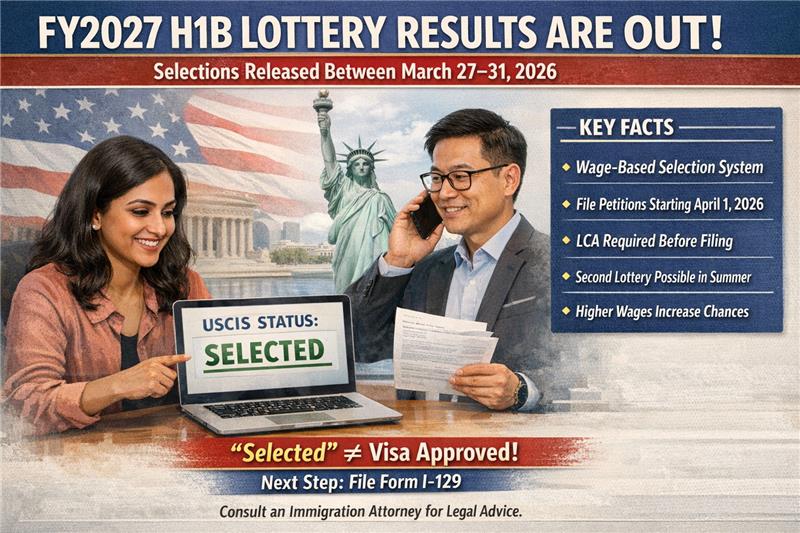
The FY2027 H-1B lottery results are being released between March 27 and March 31, 2026. Employers can check results through their USCIS accounts. If selected, they can file a petition starting April 1, 2026.
If your registration shows “Selected,” it means your employer can now file a petition on your behalf. It does not mean your visa is approved.
This year is different. The FY2027 cycle is the first to apply a wage-based selection system, which changed how candidates were picked. Higher-paid roles had a clear advantage.
Key Takeaways
- FY2027 H-1B lottery results began releasing around March 27–31, 2026
- USCIS uses a wage-based selection system for the first time
- Selection allows filing of Form I-129, but does not guarantee approval
- Petition filing window starts April 1, 2026
- Employers must file an LCA before submitting the petition
- The second lottery may occur between July and September if slots remain
- Higher wage levels significantly improved selection probability
This article is for general informational purposes only and does not constitute legal advice. Immigration law is fact-specific, and your situation may be different. Consult a licensed immigration attorney for advice on your case.
Are FY2027 H-1B Lottery Results Out?
Yes. USCIS has started releasing results for the FY2027 H-1B lottery.
Here’s the timeline based on current updates:
- Results began appearing: March 27–28, 2026
- Final notifications expected: by March 31, 2026
- Petition filing window opens: April 1, 2026
USCIS does not send emails directly to applicants. The employer or attorney who submitted the registration must log in to the USCIS portal to check the status.
There are three possible statuses:
- Selected
- Submitted
- Not Selected
“Submitted” does not mean rejection. It means your case is still in the pool in case a second lottery happens.
How the FY2027 H-1B Lottery Was Different (Wage-Based Selection Explained)
The biggest change this year is the move away from a random lottery.
Instead, USCIS prioritized registrations based on wage levels defined by the U.S. Department of Labor.
Here’s how it works:
- Level IV (highest wages) → highest priority
- Level III → next
- Level II → lower
- Level I (entry-level) → lowest priority
In practical terms, this means two candidates with identical qualifications could have very different outcomes based only on salary.
In our experience, this shift changes strategy entirely. Employers offering higher wages had a much stronger chance of selection.
What Wage Level Means for Selection Odds
Wage levels are based on prevailing wage data under federal rules.
- Level I: Entry-level roles
- Level II: Qualified workers
- Level III: Experienced professionals
- Level IV: Experts or senior roles
A common issue we encounter is employers under leveling positions to reduce costs. This year, that decision likely reduced their selection chances.
Who Benefited and Who Was Disadvantaged
Benefited:
- Senior professionals
- Tech specialists with higher salaries
- Large employers offering competitive pay
Disadvantaged:
- Fresh graduates
- Entry-level applicants
- Smaller companies with lower wage budgets
What most people don’t realize is that this system indirectly filters candidates before the petition stage even begins.
How to Check Your H-1B Lottery Results (Step-by-Step)
You cannot check your result directly unless you have access to the employer’s USCIS account.
Here’s how it works:
- Employer logs into USCIS registration account
- Opens the FY2027 registration dashboard
- Checks the status next to each beneficiary
We regularly see applicants waiting for emails that never come. USCIS communicates through the portal, not direct notifications.
If you have not heard anything, follow up with your employer or attorney.
What “Selected” Really Means (And What It Does NOT Mean)
This is where many applicants misunderstand the process.
“Selected” means:
- Your registration was picked
- Your employer is eligible to file a petition
It does not mean:
- You have an approved visa
- You can start working immediately
- You are guaranteed approval
The next step is filing Form I-129, which is the actual H-1B petition.
According to USCIS regulations under 8 CFR 214.2(h), the petition must prove:
- Specialty occupation
- Employer-employee relationship
- Correct wage level
- Proper documentation
We recently helped a client who assumed the selection meant approval. Their employer delayed filing and missed key documentation. The case received an RFE that could have been avoided.
Next Steps After H-1B Selection (April–June Filing Window)
Once selected, timing becomes critical. The filing window typically runs from April 1 to June 30, 2026
Before filing, employers must submit a Labor Condition Application (LCA) to the U.S. Department of Labor. Only after LCA approval can the petition be filed.
Required Documents for Filing
Typical documents include:
- Approved LCA
- Job offer letter
- Degree certificates
- Resume
- Employer support letter
- Proof of business operations
In our practice, incomplete documentation is one of the top reasons for delays.
Common Filing Mistakes That Lead to RFEs
Generic or vague job descriptions
Job duties that sound broad or administrative make it hard to prove a “specialty occupation.” USCIS expects clear, technical responsibilities tied to a specific field.
Degree not directly related to the role
If the candidate’s degree does not closely match the job field, USCIS will question eligibility. This comes up often with interdisciplinary roles.
Missing or weak specialty occupation evidence
Employers fail to show that the role normally requires a bachelor’s degree in a specific specialty under 8 CFR 214.2(h)(4)(iii)(A).
Inconsistent information across documents
Job title, salary, or duties not matching between the LCA, offer letter, and Form I-129 is a common red flag.
Improper third-party placement documentation
Missing client letters, contracts, or statements of work can lead to RFEs questioning whether real work exists.
Failure to prove employer-employee control
Especially in consulting cases, USCIS looks for proof that the petitioner controls the worker’s day-to-day work.
Unclear work location details
If the petition does not clearly state where the employee will work, it can raise compliance issues with LCA posting requirements.
Wrong SOC code selection
Choosing an incorrect occupational classification weakens the entire case and often leads to scrutiny.
Insufficient company documentation
Small or new companies often fail to include financials, tax records, or proof of operations, which raises credibility concerns.
Late or incomplete LCA filing
Errors in the Labor Condition Application or delays in certification can derail the entire timeline.
Overuse of Level I wages without justification
USCIS frequently questions whether entry-level wages align with complex job duties.
Missing end-client itinerary (for multi-location roles)
Not showing where and how long the employee will work at each site creates gaps in the petition.
One thing to watch for: USCIS often questions Level I positions for specialty occupation eligibility.
What If You Are Not Selected? (Second Lottery Chances Explained)
If your status shows “Submitted,” you still have a chance.
USCIS may run a second lottery if:
- Selected petitions are not filed
- Denials reduce total approvals
This usually happens between July and September.
That said, it is not guaranteed. In some years, no second lottery occurs.
FY2027 H-1B Lottery Results: Real Impact on Applicants and Employers
This year changes the long-term strategy.
For applicants:
- Salary now directly impacts selection chances
- Entry-level applicants face tougher odds
For employers:
- Wage decisions now affect lottery outcomes
- Planning must start earlier
We’ve already seen companies adjusting offers upward just to improve selection opportunities. That was not a factor in previous years.
Frequently Asked Questions
Only your employer or attorney can check results through the USCIS registration account.
It means your registration was chosen, and your employer can file a petition. It is not an approval.
The filing window typically runs from April 1 to June 30, 2026.
Possibly. USCIS may run another lottery if not enough petitions are filed or approved.
No. Only the account holder who submitted the registration can access the result.
You can begin working in H-1B status starting October 1, 2026, if approved.