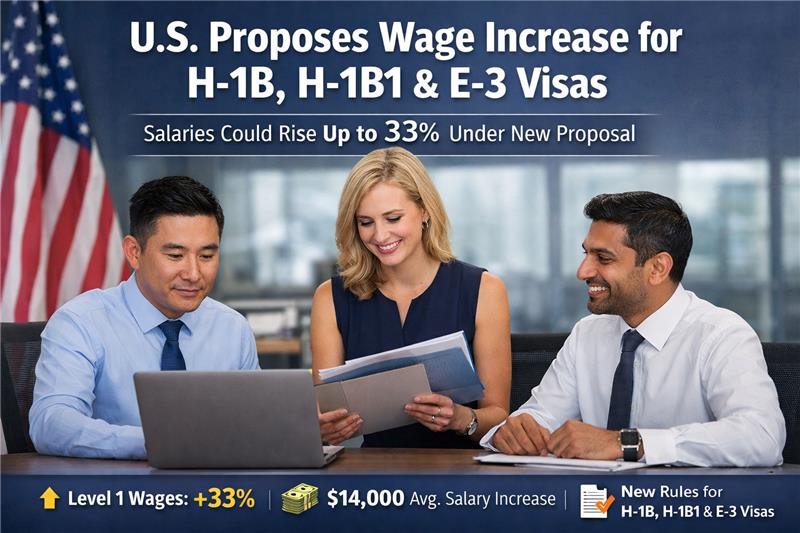
The U.S. Department of Labor has proposed increasing required wages for H-1B, H-1B1, and E-3 visas by adjusting how prevailing wage levels are calculated.
Under the proposal, Level 1 wages would rise by about 33%. The rule is still in the proposal stage and must go through the federal rulemaking process before it can take effect.
Instead of setting a flat minimum salary, the change raises wage percentiles across all four levels, which means required pay will increase depending on the role, experience level, and location.
This directly impacts both applicants and employers by increasing the salary thresholds tied to visa eligibility. If finalized, this shift will influence hiring decisions, with employers placing greater focus on roles that justify higher wage levels.
Key Takeaways
- The proposed H-1B wage increase could raise salaries by 21% to 33%
- Entry-level (Level 1) roles are expected to see the largest increases
- The rule affects H-1B, H-1B1, and E-3 visas equally
- Employers must meet updated wages through the Labor Condition Application (LCA)
- The rule is still in the proposal stage and not yet effective
- Higher wages may reduce the number of visa filings
- Policy trends show a shift toward prioritizing higher-paid roles
This article is for general informational purposes only and does not constitute legal advice. Immigration law is fact-specific, and your situation may be different. Consult a licensed immigration attorney for advice on your case.
What Is the Proposed H-1B Wage Increase?
The proposal focuses on raising prevailing wage levels, not setting a flat minimum salary across all jobs.
Here’s what that means in practice:
- Every H-1B job must meet a prevailing wage, determined by the Department of Labor
- That wage depends on:
- Job role
- Location
- Experience level
The current proposal would increase these wage benchmarks significantly. In some roles, Level 1 wages could rise the most, which is where many early-career applicants fall.
In our practice, one of the most common misunderstandings is assuming there is a single H-1B salary requirement. There isn’t. The required wage is tied to a structured system, and that system is adjusted.
How the Prevailing Wage System Actually Works (Most Miss This)
The prevailing wage system is the backbone of H-1B salary rules. Employers must file a Labor Condition Application (LCA) with the Department of Labor before submitting Form I-129 to USCIS.
That LCA confirms two key things:
- The employer will pay at least the prevailing wage
- Hiring a foreign worker will not negatively impact U.S. workers
The wage is calculated using government data, often from the Bureau of Labor Statistics.
Wage Levels Explained (Level 1 to Level 4)
There are four wage levels:
- Level 1 (Entry-Level):
Basic understanding of the role. Often, recent graduates. - Level 2 (Qualified):
Some experience. Can work independently with guidance. - Level 3 (Experienced):
Strong understanding. Handles complex tasks. - Level 4 (Fully Competent):
Senior-level. Leads projects or teams.
Here’s what we see in real cases: most first-time H-1B applicants fall into Level 1 or Level 2. That’s exactly where the biggest wage increases are expected.
Learn More About the H-1B, Wage System And Important Details
Who Benefits and Who Gets Affected the Most?
This change does not impact everyone equally.
Impact on Entry-Level Applicants
Entry-level applicants face the biggest challenge.
- Employers must pay more for Level 1 roles
- Many companies may skip junior candidates entirely
One thing that surprises many applicants is this: the visa is not just about qualifications. It is about whether an employer can justify the salary.
Impact on Employers and Hiring Strategy
Employers will need to rethink hiring decisions:
- Higher salary costs per hire
- Increased compliance scrutiny
- Potential reduction in total filings
In our experience, larger companies can absorb these costs more easily. Startups and small businesses often cannot.
What About H-1B1 and E-3 Visas?
H-1B1 (Chile/Singapore) and E-3 (Australia) visas follow the same prevailing wage system.
That means:
- Any wage increase applies to them as well
- LCAs are still required
- Salary thresholds will rise similarly
Most coverage ignores this, but the impact is real. Employers using E-3 visas as an alternative to H-1B will face the same cost pressures.
When Will the New Wage Rule Take Effect?
Right now, this is still a proposal.
Here’s the typical timeline:
- Proposal published in the Federal Register
- Public comment period (usually 30–60 days)
- Review and revisions
- Final rule issued
- Effective date set (often months later)
Based on past rulemaking timelines, this is unlikely to take effect immediately.
A common issue we encounter is employers assuming they can delay planning until the rule is final. That often leads to rushed filings and compliance risks.
How This Connects to the H-1B Lottery Changes
This proposal is part of a broader shift.
Recent policy trends show increasing focus on:
- Higher wages
- Higher-skilled roles
- Reducing misuse of entry-level filings
If wage-based selection continues to expand, salary could play a larger role in who gets selected.
The reality is simple: the system is moving toward rewarding higher-paying roles.
What Applicants and Employers Should Do Now
This is where strategy matters.
For Applicants:
- Target roles that meet higher wage levels
- Build skills that justify Level 2 or Level 3 classification
- Discuss salary expectations early with employers
For Employers:
- Review current wage structures
- Plan hiring budgets for 2026 and beyond
- File LCAs carefully and accurately
We recently advised a client to adjust job descriptions to better reflect Level 2 responsibilities. That change alone made the wage requirement more manageable and reduced risk during review.
Frequently Asked Questions
There is no single minimum salary. The required wage depends on job role, location, and experience level under the prevailing wage system.
Possibly. If they change jobs or file extensions after the rule takes effect, they may need to meet the new wage levels.
The rule is still in the proposal stage. It must go through the federal rulemaking process before becoming effective.
Yes. Any industry using H-1B, H-1B1, or E-3 visas must comply with prevailing wage requirements.
Fresh graduates are most affected because they typically qualify for Level 1 wages, which are expected to rise the most.
No. It is still under review and has not been finalized.