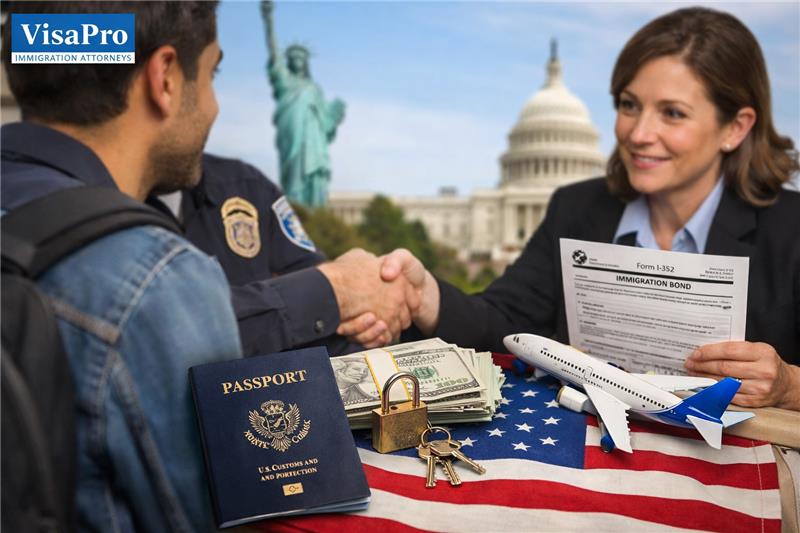
The U.S. government may require certain visitor visa applicants to post a refundable bond before receiving a visa. This policy applies to some nationals applying for B-1 (business) or B-2 (tourist) visas.
The bond can range from $5,000 to $15,000, depending on the circumstances of the application. The rule is based on immigration law provisions that allow the government to request a financial guarantee when there is concern about visa compliance.
According to the official guidance published by the U.S. Department of State, applicants from designated countries may be asked to post this bond during the visa process.
Key Takeaways
- The U.S. visa bond program applies to some B-1/B-2 applicants from specific countries
- Bond amounts range from $5,000 to $15,000
- Payment must be made through Pay.gov after the consular instruction
- Travelers must use commercial airports of entry only
- Bonds are returned if visa conditions are followed.
Legal Authority Behind the Visa Bond Program
The visa bond program is based on Section 221(g)(3) of the Immigration and Nationality Act. This provision allows the government to require a financial guarantee from visa applicants in certain situations.
The program was implemented through a Temporary Final Rule (TFR) that established a pilot system for visitor visa applicants. The policy uses overstay data from the U.S. Department of Homeland Security Entry/Exit Overstay Report to identify countries with higher rates of visa overstays.
Immigration authorities review this data to determine which nationalities may be subject to the bond requirement. The program is intended to strengthen compliance with U.S. visa rules and reduce instances where travelers remain in the country beyond their authorized stay.
What Is the U.S. Visa Bond Requirement?
Under this policy, a consular officer may ask a visa applicant to post a security bond before the visa can be issued.
Key points about the bond requirement include:
- The bond applies to B-1 and B-2 visitor visas.
- The amount may be $5,000, $10,000, or $15,000.
- The exact amount is determined during the visa interview.
- Only applicants who are otherwise eligible for a visa may be asked to post the bond.
The purpose of the bond is to provide a financial incentive for travelers to comply with the conditions of their visa. If the traveler follows the rules and leaves the United States on time, the bond is returned.
Countries Subject to Visa Bonds
The U.S. Department of State publishes an official list of countries whose citizens may be subject to visa bonds. The list can change over time as immigration data and policy priorities evolve.
The Department of State has identified nationals from these countries as needing visa bonds. The implementation dates are in parentheses:
- Algeria (January 21, 2026)
- Angola (January 21, 2026)
- Antigua and Barbuda (January 21, 2026)
- Bangladesh (January 21, 2026)
- Benin (January 21, 2026)
- Bhutan (January 1, 2026)
- Botswana (January 1, 2026)
- Burundi (January 21, 2026)
- Cabo Verde (January 21, 2026)
- Cambodia (April 2, 2026)
- Central African Republic (January 1, 2026)
- Cote D’Ivoire (January 21, 2026)
- Cuba (January 21, 2026)
- Djibouti (January 21, 2026)
- Dominica (January 21, 2026)
- Ethiopia (April 2, 2026)
- Fiji (January 21, 2026)
- Gabon (January 21, 2026)
- The Gambia (October 11, 2025)
- Georgia (April 2, 2026)
- Grenada (April 2, 2026)
- Guinea (January 1, 2026)
- Guinea-Bissau (January 1, 2026)
- Kyrgyz Republic (January 21, 2026)
- Lesotho (April 2, 2026)
- Malawi (August 20, 2025)
- Mauritania (October 23, 2025)
- Mauritius (April 2, 2026)
- Mongolia (April 2, 2026)
- Mozambique (April 2, 2026)
- Namibia (January 1, 2026)
- Nepal (January 21, 2026)
- Nicaragua (April 2, 2026)
- Nigeria (January 21, 2026)
- Papua New Guinea (April 2, 2026)
- Sao Tome and Principe (October 23, 2025)
- Senegal (January 21, 2026)
- Seychelles (April 2, 2026)
- Tajikistan (January 21, 2026)
- Tanzania (October 23, 2025)
- Togo (January 21, 2026)
- Tonga (January 21, 2026)
- Tunisia (April 2, 2026)
- Turkmenistan (January 1, 2026)
- Tuvalu (January 21, 2026)
- Uganda (January 21, 2026)
- Vanuatu (January 21, 2026)
- Venezuela (January 21, 2026)
- Zambia (August 20, 2025)
- Zimbabwe (January 21, 2026)
How the Visa Bond Process Works
The visa bond requirement follows a specific process during the visa application stage. The applicant attends a visa interview at a U.S. embassy or consulate.
The consular officer reviews the application. If the officer determines that a bond is necessary, the applicant will be instructed to post one.
The applicant must complete Form I-352, Immigration Bond, issued by the U.S. Department of Homeland Security.
Payment is made through Pay.gov. Applicants receive a direct payment link to submit the bond through the U.S. Department of the Treasury’s Pay.gov platform.
This official payment system is the only authorized method for posting the bond.
Important Payment Rules Applicants Must Know
The U.S. government provides several important warnings about the bond payment process.
Applicants should only submit Form I-352 after receiving instructions from a consular officer. If someone attempts to pay the bond before being directed to do so, the payment will not be processed properly.
Applicants must also use the official payment link provided through Pay.gov. The government advises travelers not to use third-party websites or intermediaries to post the bond.
Another critical point is that paying the bond does not guarantee that a visa will be issued. The visa decision is still made by the consular officer after reviewing the application.
If fees are paid without official instruction, those payments may not be refunded.
Required Ports of Entry for Visa Bond Holders
Travelers who post a visa bond must follow strict entry and exit rules.
Visa bond holders are required to enter and leave the United States through commercial airports of entry, including locations where U.S. Customs and Border Protection operate preclearance facilities.
Travel through the following locations is not permitted for visa bond holders:
- Charter flights
- General aviation airports
- Land border crossings
- Sea ports
If a traveler fails to follow these rules, entry may be denied, or their departure may not be properly recorded in the immigration system.
Visa Bond Compliance and Automatic Refund
The bond is not permanent. In most situations, the money is returned automatically when the traveler complies with the visa rules.
The bond will be canceled and refunded when:
- The traveler leaves the United States before the authorized stay expires, and the departure is recorded by the U.S. Department of Homeland Security.
- The traveler never uses the visa before it expires.
- The traveler applies for admission at a port of entry and is denied entry.
Once these conditions are met, the bond is canceled and the payment is returned.
What Happens if Visa Bond Terms Are Violated
If immigration authorities believe the bond terms were violated, the case may be reviewed by U.S. Citizenship and Immigration Services.
Examples of possible violations include:
- Leaving the United States after the authorized stay period.
- Remaining in the country beyond the allowed time.
- Applying to adjust status from a nonimmigrant visa, including submitting an asylum application.
If a violation is confirmed, the bond may be considered breached, and the money may not be returned.
Frequently Asked Questions
A visa bond is a refundable financial guarantee that some B-1/B-2 visa applicants must post before receiving their visa.
The amount can be $5,000, $10,000, or $15,000, depending on the consular officer’s decision.
Applicants who are instructed by a consular officer to post a bond must complete Form I-352 Immigration Bond.
No. The visa decision is still made by the consular officer after reviewing the application.
The bond is returned if the traveler follows the visa rules and departs the United States before the authorized stay expires.